
A patient can now generate meaningful health data while sleeping, exercising, filling a prescription, undergoing a scan, or simply wearing a sensor. The result is a healthcare system that increasingly knows more about patients between appointments than it once learned during them.
But collecting data is the easy part. The harder challenge is connecting fragmented records, separating useful signals from noise, protecting sensitive information, and turning millions of observations into decisions clinicians can actually trust. That is where big data is beginning to change healthcare most profoundly.
Healthcare’s Data Explosion
Healthcare data is no longer confined to hospital records. Electronic health records contain diagnoses, prescriptions, laboratory results, clinician notes, procedures, and years of treatment history. Imaging systems add CT scans, MRIs, X-rays, pathology slides, and other high-resolution files. Genomic sequencing introduces another layer containing vast numbers of biological variables.
Then there is data produced outside traditional healthcare settings. Continuous glucose monitors collect measurements throughout the day. Smartwatches track heart rate, sleep, activity, and sometimes electrical heart signals. Remote cardiac devices can follow patients for weeks rather than minutes.
The important change is not simply that healthcare has more information. It is that the information arrives in different formats, at different speeds, and from systems that were rarely designed to work together.
| Data source | What it can reveal | Main challenge |
| Electronic health records | Diagnoses, treatments and clinical history | Inconsistent and fragmented documentation |
| Medical imaging | Structural and visual signs of disease | Very large files and specialist interpretation |
| Wearables | Continuous physiological patterns | Noise and variable sensor quality |
| Genomic data | Genetic variants linked to disease or treatment | Complexity and privacy |
| Pharmacy data | Medication use and prescribing patterns | Records may span multiple providers |
| Claims data | Long-term healthcare utilization | Designed for billing rather than clinical analysis |
Healthcare therefore has a data-engineering problem before it has an AI problem. Information must be cleaned, standardized, linked to the correct patient, timestamped properly, and given enough context to become useful.
From Records to Predictions
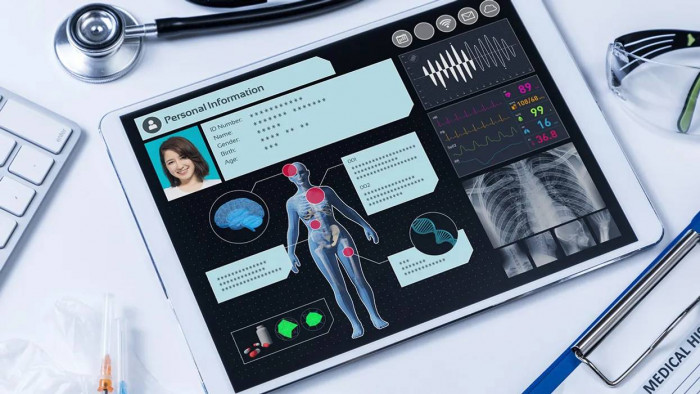
Traditional medical records mainly explain what has already happened. Big-data systems increasingly attempt to estimate what may happen next.
Machine-learning models can examine combinations of laboratory results, vital signs, previous admissions, medications, demographics, and clinical notes to identify patients who may face elevated risks of deterioration, readmission, complications, or particular diseases.
The advantage comes from detecting relationships that are difficult to notice one variable at a time. A blood-pressure reading might look unremarkable on its own. Combined with a rising respiratory rate, changing kidney markers, fever, and recent clinical notes mentioning confusion, the overall pattern may justify closer attention.
This is not the same as allowing software to make a diagnosis independently. In many useful applications, AI acts more like a prioritization layer. It identifies which records or patients deserve another look.
The technology is already entering everyday medical work. An American Medical Association survey published in March 2026 found that 81% of surveyed physicians used AI professionally, compared with 38% in 2023. Common uses included summarizing medical research, creating clinical documentation, generating chart summaries, and assisting with diagnosis.
As adoption rises, however, the quality of the underlying data becomes increasingly important.
AI Inherits Data Problems
A sophisticated algorithm cannot automatically repair weaknesses in the records used to train or operate it.
Healthcare datasets contain missing values, duplicate records, inconsistent diagnostic codes, outdated information, manual entry errors, and measurements collected under different circumstances. A blank field can mean that a test was unnecessary, unavailable, forgotten, or performed somewhere else. To software, those possibilities may initially look identical.
Historical data can also preserve historical inequality. If certain communities received fewer diagnostic tests or had less access to specialist care, a system trained on those records may learn patterns produced by access problems rather than biology.
Three technical issues deserve particular attention:
● Models may perform differently outside their original hospital. Different populations, equipment, documentation practices, and treatment protocols can alter the meaning of familiar variables.
● Data drift can quietly reduce accuracy. Disease patterns, clinical workflows, patient demographics, and medical technology change after a model has been deployed.
● Missing context can create false confidence. An algorithm may recognize a statistical pattern without understanding why the pattern exists or whether it applies to the patient in front of a clinician.
Healthcare AI therefore needs ongoing validation, data lineage, version control, bias testing, and performance monitoring. Accuracy measured during development is only the starting point. The wider problem with AI guidance is that a convincing recommendation can still be built on incomplete, outdated, or poorly interpreted data.
Personalized Care Gets Practical
Big data also allows medicine to divide patients into more meaningful groups than age, diagnosis, and disease stage alone.
A treatment decision can potentially draw from medical history, imaging, genetics, biomarkers, previous treatment response, medications, lifestyle information, and other variables. The goal is not to create a completely unique therapy for every person but to make treatment selection more specific.
Oncology demonstrates the idea clearly. Two tumors in the same organ can contain different molecular characteristics. Genetic and pathology information can help determine whether a tumor carries a mutation targeted by a particular therapy.
Pharmacogenomics applies similar reasoning to medication. Genetic variation can influence how quickly someone metabolizes a drug, whether the treatment is likely to work, or whether the patient has an elevated risk of adverse effects.
The danger is assuming every correlation deserves clinical action. If thousands of variables are analyzed simultaneously, algorithms will inevitably find patterns. Some will be clinically meaningful; others will be accidental, indirect, or specific to one dataset.
Personalized medicine therefore depends on something less exciting than prediction but more important: evidence showing that acting on a prediction actually improves outcomes.
Hospitals Become Predictive Systems
Big data is changing what happens behind the examination room as well. Hospitals deal with fluctuating emergency admissions, staffing shortages, operating-room delays, bed constraints, equipment maintenance, missed appointments, and unpredictable medication demand. Each process creates historical data that can be used for forecasting.
An emergency department can examine seasonal demand, arrival patterns, admission rates, and local trends to estimate when pressure is likely to rise. Scheduling systems can identify appointment slots with unusually high cancellation risk. Operating-room data can expose procedures that consistently exceed planned durations.
The benefit is not simply cost reduction. Operational failures eventually become clinical problems. A delayed bed transfer can keep a patient in an emergency department longer. Poor scheduling can increase waiting times. An inventory problem can affect treatment availability.
This is why the modern hospital increasingly resembles a real-time information system. Clinical data describes what is happening to patients while operational data describes whether the organization has the resources to respond.
The Audit Trail Behind Care
As data-driven recommendations become part of everyday healthcare, the clinical record may eventually need to capture more than what a doctor decided. It may also need to preserve what information an algorithm received, what it returned, and how that output influenced the decision.
Imagine a risk model flagging one patient as low priority and another as urgent. If the first patient's condition later deteriorates, investigators may need to determine whether the underlying records were complete, whether the correct model version was running, whether an alert appeared properly, and whether a clinician followed or rejected it. Similar questions can emerge when disputed medical outcomes lead people to seek information about accountability, including resources such as a Medical Malpractice Lawyer West Palm Beach. The wider technology issue is that digital healthcare must preserve enough evidence to reconstruct how an important decision was reached.
That makes auditability a design requirement rather than an administrative extra. Logs should show which data entered a system, when it was processed, which model produced an output, what confidence or risk score appeared, and how users responded. Without that history, sophisticated automation can actually make a clinical decision harder to explain.
Privacy Moves Into Architecture
Healthcare privacy cannot be solved by putting stronger passwords on larger databases. The value of big data comes from combining information, yet every additional connection expands the consequences of unauthorized access. Genomic information is particularly sensitive because it is deeply personal and cannot simply be replaced like a compromised password.
Modern privacy therefore has to be built into the data architecture. Encryption protects information in transit and storage. Role-based access controls limit who can see specific records. Audit logs reveal inappropriate access, while data-minimization policies reduce unnecessary collection.
Other technologies attempt to extract value without moving every underlying record. Federated learning, for example, can allow models to learn from data stored at several institutions while the raw patient records remain local. Differential privacy can add controlled statistical noise to aggregated results, making it more difficult to infer information about one individual.
These methods do not make healthcare data risk-free, but they challenge the assumption that every useful dataset must first be copied into one enormous central repository.
Interoperability Is Still Hard
Big data becomes far less useful when hospitals, laboratories, pharmacies, insurers, and consumer devices cannot interpret one another's information.
The United States has made progress. Federal health IT figures show that 76% of non-federal acute-care hospitals participated in all four measured electronic exchange activities in 2025: sending, receiving, finding, and integrating health information. Sending reached 96%, while integration remained lower at 79%.
That gap matters. Sending a record is not the same as making its information immediately usable inside another system.
FHIR, or Fast Healthcare Interoperability Resources, helps by defining standardized ways for healthcare applications to exchange data through APIs. A medication, observation, patient record, or diagnostic report can be represented in a more predictable format.
Yet technical connectivity is only part of the problem. Systems still need consistent medical terminology, reliable patient matching, permission controls, and rules governing which version of conflicting information should be trusted.
Healthcare cannot become genuinely data-driven while important information remains trapped in incompatible systems.
Continuous Data Changes Care
Traditional healthcare works mainly with snapshots. Blood pressure is measured during an appointment. An ECG records the heart for a limited period. A glucose test captures one moment.
Connected devices turn those snapshots into timelines. Continuous glucose monitors reveal how levels change after meals, exercise, sleep, and medication. Wearable cardiac devices can capture irregular rhythms that may not occur during an office visit. Remote monitoring can allow clinicians to follow selected patients after discharge without keeping them physically inside a hospital.
Continuous monitoring creates its own problems, however. More readings also create more opportunities for false alarms.
A useful remote-monitoring system therefore needs more than sensors:
● Thresholds must distinguish clinically meaningful changes from ordinary variation rather than alerting clinicians whenever a number moves.
● Device data needs context because the same heart rate can mean very different things during exercise and sleep.
● Escalation rules must specify who receives an alert, how quickly it should be reviewed, and what happens when no one responds.
● Sensor reliability has to be understood before consumer-device measurements are treated like clinical-grade observations.
The future is not healthcare professionals watching endless dashboards. It is software reducing enormous streams of measurements into a manageable number of meaningful signals.
Big Data at Population Scale
The same infrastructure can reveal patterns that are invisible in individual patient records. Aggregated datasets can identify areas with rising chronic disease, unusual hospitalization rates, gaps in preventive screening, medication trends, or changing patterns of infectious disease. Combining clinical and geographic information can also expose differences in healthcare access.
Non-medical datasets increasingly matter here. Transportation availability, pollution, housing conditions, income, pharmacy access, and distance from medical facilities can help explain why similar patient groups experience different outcomes.
But population analytics also creates a serious risk: turning correlation into policy without understanding its cause.
Suppose historical data shows that people in one postcode miss more appointments. That information could justify transportation assistance or different scheduling options. Used carelessly, the same prediction could lead a system to allocate fewer resources to those patients.
A technically accurate prediction can therefore produce a poor decision if the system does not understand what generated the pattern.
Healthcare's Next Data Layer
Healthcare AI is moving quickly from experiments into regulated products. The FDA reported in September 2026 that it had authorized more than 1,600 AI-enabled medical devices for marketing in the United States.
The next step is likely to be greater integration between data types. Instead of separate systems examining scans, laboratory values, clinical notes, or wearable readings, multimodal models will increasingly attempt to interpret several sources together.
The surrounding infrastructure will have to mature at the same time. Hospitals will need systems for monitoring model drift, recording software versions, validating outputs across different patient groups, managing permissions, and determining when automated recommendations require human review.
AI assistants may also change how clinicians interact with records. Instead of opening multiple screens to reconstruct a five-year medical history, a clinician could ask software to summarize major changes, retrieve relevant tests, or identify medication conflicts. The quality of that answer, however, will still depend on whether the underlying records are complete and correctly connected.
Better Beats Bigger
Healthcare does not need data simply for the sake of having more of it. A billion additional measurements add little value if they are fragmented, poorly labeled, biased, inaccessible, or impossible to interpret in time.
The more important transformation is the movement from isolated records toward connected evidence. Predictive systems can identify emerging risks, genomic information can make some treatments more precise, operational analytics can improve hospital capacity, and remote devices can extend observation beyond the clinic.
But every advance increases the importance of the infrastructure underneath it. Interoperability determines whether information can move. Provenance determines whether it can be trusted. Privacy architecture determines how safely it can be used. Audit trails determine whether important decisions can later be understood.
Big data is reshaping healthcare because medicine is becoming increasingly computational. The strongest systems will not be those that simply collect the most information. They will be the ones capable of turning complex data into evidence that clinicians can verify, question, explain, and use at the moment it matters.





Comments