
We generate more information in a single day than most of us can meaningfully track, yet the hardest part has never been holding onto it; it has been finding it again at the exact moment we need it. Studies of knowledge workers have long put the cost of that failure at roughly one full workday a week, with IDC and Gartner figures placing daily information hunting at around 30 percent of working hours.
The instinctive fix has always been better filing: neater folders, stricter naming, one more layer of subfolders. That instinct is now obsolete.
The real bottleneck was never storage hard drives that got cheap decades ago. It was structure and retrieval: imposing order on messy information, then locating the right piece inside it. That is precisely the problem artificial intelligence attacks, and in doing so it is changing not just our tools but the mental model we use to organize our lives.
Three Eras: Filing, Finding, Foreseeing
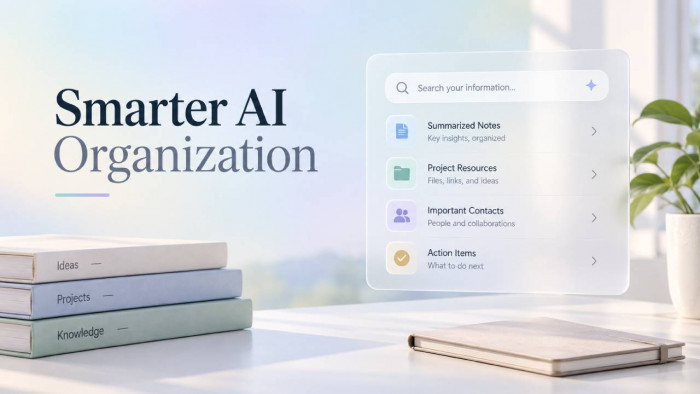
To see where this is heading, it helps to compress the history of personal information management into three overlapping eras. Each one asked less of the human and more of the machine.
◦ Filing. For most of the computing age, we were the librarians. We built folder hierarchies, invented naming conventions, and maintained our own taxonomies by hand. The system knew nothing; all the structure lived in our heads and our discipline.
◦ Finding. Full-text search broke that contract. Once a machine could scan every document in milliseconds, filing mattered less so we stopped organizing and started searching. The catch was that we had to remember the right keywords the file actually contained.
◦ Foreseeing. AI removes even that requirement. Systems now interpret meaning, connect related ideas we never linked, and surface what we are likely to need before we phrase a query. The structure is generated for us, on demand.
We are living in the messy overlap of all three. Understanding that arc filing to finding to foreseeing is the thread that makes sense of every tool discussed below.
The Death of the Folder
The folder is the most durable metaphor in computing. It arrived with the desktop interface of the 1980s, borrowed straight from the physical office, and it carried one fatal assumption: that every item belongs in exactly one place.
Real information refuses to cooperate. A contract is simultaneously a legal document, a client record, a financial obligation, and a dated event. Filed under “Clients,” it vanishes from anyone thinking in terms of “Contracts.” We have all felt this, the second of hesitation about which folder something goes in is the system failing in real time.
AI dissolves the single-location rule. Instead of one home per item, everything lives in one pool and the system derives structure on the fly tagging, grouping, and relating items by what they mean rather than where we dragged them. The question shifts from “where did I put this?” to “what is this about?”, and that second question is one a machine can now answer.
The folder assumed every item has one home. Information never did and pretending otherwise is why we lose things.
None of this means structure disappears; it means the structure becomes invisible and plural. The same document can appear under a client, a date, a topic, and a dollar figure at once, because the system is not moving a file into one drawer, it is describing the file from many angles simultaneously. We stop maintaining the map and start asking the territory questions.
How Machines Actually “Understand” a Document
The mechanism behind this deserves plain explanation, because it is where the real shift lives. Traditional search matches characters: type invoice and it finds the letters i-n-v-o-i-c-e. Miss the exact word and you miss the file, even if the document is about billing on every line.
Modern systems work on meaning instead, using a technique called embeddings. Each piece of text is converted into a long list of numbers, a vector that captures its semantic content. Texts about similar ideas end up close together in this mathematical space, even when they share no words at all.
The practical consequence is large: a search for “money owed to us” can now surface a document titled “outstanding receivables,” because the system understands the two phrases point at the same concept. It is the difference between a machine matching spelling and a machine grasping subject. That single change is what powers nearly everything else in this article.
| Keyword matching vs. semantic understanding | ||
| Capability | Keyword search | Semantic (AI) search |
| Matches on | Exact characters | Meaning and context |
| “Money owed to us” | Finds nothing | Finds “outstanding receivables” |
| Handles synonyms | No | Yes, natively |
| Fails when | You forget the exact word | The concept is genuinely absent |
From Keyword to Question
Once a system understands meaning, the way we interrogate our own information changes shape entirely. The old model forced us to translate a real question into search terms: we wanted to know “how much did we spend on contractors last quarter,” but we typed invoice contractor Q3 and then reassembled the answer ourselves from whatever came back.
Natural-language retrieval collapses that translation step. We now ask the actual question and receive the actual answer, assembled from across dozens of documents that the system read on our behalf. The labor of gathering and synthesizing moves from the person to the machine.
This is subtler than it sounds. It means we no longer need to know where an answer lives, or even that a relevant document exists. We describe the outcome we want, and retrieval works backward to the evidence. Our own archives become something we can converse with rather than dig through.
The organizational consequence follows directly. If we can ask a plain-language question and get a synthesized answer, the pressure to pre-organize everything into perfect categories evaporates. We can afford to keep information in a rough, unsorted heap, because the effort of imposing order has moved to the moment of asking rather than the moment of saving and it is the machine, not us, that pays it.
The Second Brain, Automated
First-generation note tools still relied on us to link and revisit; AI turns a passive archive into an active one.
A whole movement grew up around the idea of a “second brain” personal knowledge tools where people capture notes, ideas, and references to offload memory onto software. The first generation still leaned on the human: we had to link our own notes, tag them, and revisit them to keep the web alive.
AI turns that passive archive into an active one. The value is not in what these systems store, but in what they resurface on their own:
◦ Automatic connection. A note taken today is silently linked to a related thought captured eight months ago, building a web of associations no one had to maintain by hand.
◦ Resurfacing at the right moment. Instead of waiting to be searched, the archive pushes a forgotten but relevant note back into view while we are working on something it relates to.
◦ Compression on demand. A sprawling folder of meeting notes collapses into a two-line summary, or expands back into detail, depending on what the moment requires.
The behavioral change is real: capturing information stops being a promise to organize it later, a promise most of us break because the organizing no longer depends on our follow-through.
Turning Chaos Into Structure
Most of the important information in our lives is not tidy data in a spreadsheet. It is unstructured mess email threads, PDF attachments, scanned letters, screenshots, photographed receipts. Historically, extracting anything usable from that pile meant reading all of it ourselves.
This is where AI does its least glamorous and most valuable work. It reads the mess and pulls out the structure hiding inside: the dates, names, amounts, parties, and obligations buried in prose and image. A folder of scanned documents becomes a queryable list of who owes what to whom and by when.
Consider a single scanned agreement. From that one image, a modern system can extract the parties involved, the effective date, every deadline it contains, the payment terms, and the conditions that trigger an obligation then file each of those into a timeline and a reminder without a human transcribing a word. Unstructured input becomes structured, actionable output. That capability is the quiet engine under most of the “AI organization” products now on the market.
The shift here is from documents to facts. Under the old model, the unit we stored was the file, and any fact inside it stayed trapped there until a person opened it. Now the meaningful unit is the fact itself a due date, an amount, a named party extracted and connected across every document it appears in. We stop managing files and start managing the information those files were only ever a container for.
When Getting It Right Actually Matters
Organizing photos badly costs you a memory. Organizing certain information badly costs you far more. In a handful of domains medicine, finance, and law among them the arrangement of information is not a matter of convenience but of consequence, because a missed date or a misfiled record has a hard, sometimes irreversible cost.
Law is the clearest example, and it shows both the promise and the limit of these tools in one frame. A legal matter generates an avalanche of time-sensitive, high-stakes information: filing deadlines, court dates, financial disclosures, and documents that must be produced in a specific form at a specific time. Missing one is not an inconvenience; it can decide the outcome.
This is exactly the environment where an AI-driven organization proves its worth and where its boundary becomes visible. Software can scan a stack of filings, extract every deadline, and flag the one that falls next week, which is why a practising Lake Charles family lawyer increasingly leans on these systems to keep a caseload of dates and records straight. But surfacing a deadline is not the same as deciding what it means for a specific client, and the judgment about how to act on the organized information stays firmly with the professional. The tool wins back the hours once lost to hunting through files; the human still owns the decision.
The Trust Problem: Hallucinations and Provenance
Here is the counterweight the marketing tends to skip. An AI that confidently misfiles a document is a nuisance. An AI that confidently invents one is a hazard. Language models can produce fluent, plausible answers that are simply wrong and a wrong answer delivered with total confidence is more dangerous than an honestly messy folder, because it does not look like a failure.
The industry's answer is a design pattern often shortened to grounding: instead of letting a model answer from memory, the system first retrieves the relevant source documents and forces the answer to be built from them. The most important feature this enables is provenance: the ability to click a claim and see exactly which document and passage it came from.
That single capability separates a tool we can trust with important information from one we cannot. A system that says “your payment is due the 15th” is useful only if it can also show us the specific line in the specific contract that says so. There is even a documented failure mode, an answer arriving with a citation that turns out to be irrelevant or outdated which is why the ability to verify, not just receive, is now the real test of these systems.
| ~30% | 1 day | $23B+ |
| of the average knowledge worker's day spent hunting for information (IDC) | per working week lost to searching, per long-running McKinsey findings | 2025 value of the knowledge-management software market, expanding fast |
Who Owns the Organized You?
To organize your life, a system has to read your life which makes data ownership the quiet cost of convenience.
There is an uncomfortable bargain at the center of all this. For a system to organize your life, it has to read your life. Every email it sorts, every document it summarizes, every deadline it extracts is private information handed to software and often, through that software, to a company's servers.
This raises questions that have nothing to do with convenience and everything to do with control. Where does the processing happen on your own device, or in someone else's cloud? Who can see the derived picture of you that emerges once thousands of scattered documents are connected into a coherent whole? Is that organized profile something you own, or something you rent access to?
The trade is not automatically a bad one, but it should be a conscious one. On-device processing keeps sensitive material local at some cost to capability; cloud processing is more powerful but asks for more trust. The more genuinely useful these organizers become, the more of ourselves we feed them and the more the terms of that exchange deserve our attention rather than a reflexive click on “agree.”
There is a second-order risk worth naming. Once scattered records are connected into a single coherent profile, that profile is more revealing than any individual document and more valuable to anyone who might want it, from advertisers to a party in a dispute. A pile of unrelated files is hard to weaponize; a neatly organized life story is not. The convenience of connection and the exposure it creates are the same feature seen from two sides.
Designing for Human Memory, Not Against It
A quiet risk runs beneath the convenience: a tool that remembers everything for us can gradually erode our own capacity to remember anything. If we never again have to recall where something is or how pieces connect, we may lose the mental muscles that once did that work.
The better design philosophy treats these systems as a lever for human memory rather than a replacement for it. The distinction is between a crutch, which lets an ability wither, and a lever, which multiplies a capability we still possess.
In practice that means tools that show their reasoning and keep us in the loop rather than hiding the machinery surfacing a connection and letting us judge it, rather than silently deciding for us. The aim is not to think for us, but to hand us the right piece of our own knowledge at the moment we can act on it, and leave the thinking where it belongs.
From Storage to Understanding
Return to the arc we began with. The filing era asked us to be librarians of our own lives. The finding era freed us from filing but still made us remember the right words. The foreseeing era, now arriving, asks almost nothing of us at the point of retrieval the structure is generated, the answer assembled, the relevant thing surfaced before we ask.
The through-line is a migration of effort from human to machine, and with it a migration of the whole problem. For decades the challenge of important information was holding onto it. That challenge is effectively solved; storage is infinite and cheap. The frontier has moved to understanding turning what we have kept into something we can actually use at the right moment.
That is the real change underway. We are not simply getting better filing cabinets. We are moving past the cabinet entirely, toward information that arranges itself around our questions instead of waiting, inert, to be found.




Comments