
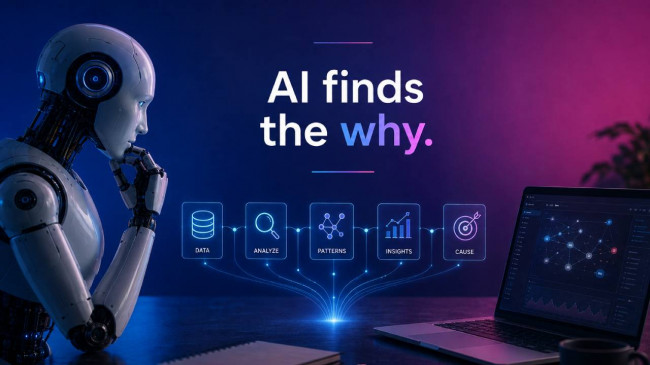
An incident rarely arrives as a complete story. A system outage leaves logs, a collision leaves telemetry and video, a fraud event leaves transaction records, and an equipment failure leaves sensor readings across several platforms. The difficult work begins afterward, when someone has to turn those fragments into a reliable sequence and separate the trigger from everything that merely happened nearby.
AI is becoming useful in that gap because it can process evidence at a scale that manual investigation struggles to match. Its strongest role is not producing a polished explanation on demand, but organizing timelines, connecting records, testing competing hypotheses and showing where the evidence is strong, weak or missing.
Every Event Leaves a Data Trail
Modern systems record far more of their own behavior than they once did. Cloud applications generate logs and traces, vehicles record operational data, phones preserve location and motion signals, factories collect machine telemetry, and security platforms capture authentication and network activity. An investigation that once relied on a final system state or witness account can now begin with thousands or millions of timestamped observations.
The resolution of that evidence is also improving. In the United States, federal rules for vehicle event data recorders are moving from a five-second pre-crash window sampled at 2 Hz toward a 20-second window sampled at 10 Hz, with phased implementation for newer vehicles. A longer, denser record can preserve steering, speed, braking and other changes that help explain how a situation developed rather than simply showing that a crash occurred.
The same principle applies elsewhere. In software, the final error message may be less informative than a configuration change fifteen minutes earlier, while a manufacturing shutdown may be preceded by temperature drift or vibration changes that looked harmless individually. AI becomes useful when evidence is too distributed and detailed for efficient manual reconstruction.
Timelines Are the First AI Advantage
Before anyone can explain why an event occurred, the available records need to agree on what happened first, what happened next and which systems were affected. That becomes difficult when an incident crosses several platforms with different timestamps, identifiers and data formats.
A cloud outage may involve application logs in one system, database metrics in another, deployment records in a third and network telemetry elsewhere. AI-assisted tools can normalize timestamps, cluster related events and identify the point where normal behavior changed, reducing the amount of manual reconciliation required before deeper analysis begins.
A service failure might initially look like a database problem, yet the reconstructed timeline may reveal a different sequence: a software release changes query behavior, database latency rises, dependent services begin retrying requests, traffic multiplies, and the database eventually becomes overloaded. The important result is not the summary itself, but the compression of a huge event stream into a sequence that can still be checked against the underlying records.
Multimodal Evidence Changes the Picture
Many incidents are documented in several data types at once. A road collision can generate vehicle telemetry, dash-camera footage, location records, photographs and emergency communications, while an industrial failure may involve sensor readings, maintenance documents, worker reports and surveillance video.
Multimodal AI is relevant because it can analyze these sources within one investigation rather than treating each as an isolated task.
| Evidence source | What AI can help extract |
| System logs and traces | Sequence, dependencies, errors and abnormal state changes |
| Video and images | Movement, objects, visible damage and environmental changes |
| Audio | Speech, alarms, timing cues and changes in background conditions |
| Sensor streams | Threshold breaches, drift, spikes and correlated physical changes |
| Location records | Movement, route, proximity and time spent at specific points |
| Documents and messages | Prior decisions, instructions, warnings and operational context |
AI does not make every source equally reliable because video can have blind spots, timestamps can be wrong and sensors can fail. Its advantage is that contradictions become easier to surface when evidence is compared across formats rather than summarized separately.
Anomalies Point to the Useful Moment
A visible failure is often the last event in a longer chain, so root-cause analysis improves when investigators identify the earlier moment where behavior first diverged from normal.
Anomaly detection is well suited to this task because models can compare an incident with large volumes of historical behavior. They can flag an authentication pattern that differs from previous account activity, a machine vibration signature that shifted before a breakdown, or a change in API latency that appeared shortly after a software deployment.
The key is not to treat anomaly as causation. An unusual event deserves attention because it narrows the search area, but something can be unusual without being responsible for the outcome. A sudden traffic spike may coincide with an outage while the real trigger is a memory leak introduced hours earlier, making anomaly detection most useful as an investigative filter rather than a final explanation.
What Happened Is Not Why It Happened
AI can often reconstruct observations with greater confidence than it can justify causal explanations. A system may establish that a vehicle slowed at a particular moment, a server's memory consumption increased after a deployment, or an account logged in from a new location before a suspicious transfer. Those facts can be supported directly by records, while causality requires another level of reasoning.
| Reconstruction question | Causal question |
| Which event occurred first? | Did the earlier event produce the later one? |
| What changed from normal behavior? | Was that change necessary or coincidental? |
| Which systems were involved? | Which dependency carried the failure forward? |
| What evidence supports the timeline? | What competing explanation also fits the evidence? |
| Where are the gaps? | Could missing evidence change the conclusion? |
This is where AI becomes misleading if it is optimized for fluency rather than investigation. A coherent narrative can still confuse correlation, sequence and causation, so a serious analytical system needs permission to stop at “the evidence supports several explanations” when the record does not justify a single cause.
Root Cause Requires Dependency Models
Root-cause analysis becomes more useful when AI understands how parts of a system depend on one another. In software operations, observability platforms combine metrics, traces and logs because one error message rarely explains a distributed failure.
Consider an online service that becomes unavailable. The final alert might say the database stopped responding, but the real chain could begin with a configuration change that increases query volume. Higher latency then causes application retries, retries multiply traffic, and the additional load pushes the database beyond capacity. Calling the event a “database outage” describes the endpoint while missing the mechanism.
AI can help construct dependency graphs showing how an earlier change propagated through connected systems. Similar models can be applied to industrial equipment, transportation networks, supply chains and financial platforms where failures travel through dependencies rather than staying in one component.

Security operations show the practical value of reducing manual correlation. IBM's 2024 Cost of a Data Breach research found that two-thirds of organizations in its study were using AI and automation in security operations, while organizations using those capabilities identified and contained breaches nearly 100 days faster on average. AI used in prevention workflows was also associated with an average breach-cost reduction of about $2.2 million compared with organizations that did not deploy it there.
When Digital Evidence Becomes Consequential
The same reconstruction methods become sensitive when the outcome affects insurance, safety, liability or other real-world decisions. A serious road incident, for example, may leave vehicle telemetry, timestamps, photographs, location records and communications that establish parts of the sequence more precisely than memory alone.
That information may later be reviewed by insurers, investigators, medical professionals or a Greenville car accident attorney. AI can help organize and compare those records, but deciding what the evidence establishes still requires verification, context and professional judgment. The useful role of the technology is to make the factual record easier to interrogate, not to turn a machine-generated reconstruction into an automatic conclusion.
Provenance Matters More Than Fluency
Once AI begins summarizing evidence, a critical question follows: can every important claim be traced back to its source? An investigative system should never make an observed fact and a model inference look identical.
If the system says a machine overheated at 14:07, the analyst should be able to see which sensor recorded the temperature, whether that sensor was functioning normally and whether its clock was synchronized correctly. If the system says an operator responded late, it should distinguish a documented timestamp from an inference based on missing activity.
Good provenance means the system should:
● Identify the exact record supporting a claim, rather than forcing an investigator to search the original dataset again.
● Show important transformations, including time normalization, transcription or image processing that changed the original representation.
● Keep contradictory evidence attached to the conclusion, so a convenient majority of signals does not silently erase competing information.
● Label machine inference separately from direct observation, particularly when downstream decisions may depend on the distinction.
This is why explainability is more than a cosmetic feature in investigative AI. NIST's AI Risk Management Framework treats validity, reliability, accountability, transparency, explainability and interpretability as core characteristics of trustworthy AI, while emphasizing stronger testing and human intervention when systems cannot detect or correct their own errors.
Confidence Should Be Claim-Specific
Many AI interfaces return one answer with one tone of confidence even though different parts of the answer rest on very different evidence. That design is particularly poor for reconstruction work.
An incident report might establish a timestamp with near certainty because several independent systems recorded it, while only inferring the reason for a person's action from indirect evidence. Presenting both claims with equal confidence makes the output easier to read but less useful to investigate.
A stronger system would separate conclusions into categories such as confirmed, probable, possible and unresolved, while showing why each claim belongs in that category. It should also allow confidence to change when new evidence appears instead of preserving the first explanation as a fixed answer. This helps human reviewers spend time on uncertain links rather than repeatedly checking facts that several independent sources already confirm.
Counterfactuals Test the Explanation
A timeline describes sequence, but causal analysis often requires a harder question: would the outcome still have occurred if one earlier condition had been different?
Engineers investigating an outage might ask whether the system would have remained stable without a particular deployment. An industrial team could model whether a machine would still have failed if cooling had remained within its normal range, while transportation analysts may compare different trajectories to understand whether a specific input materially changed the outcome.
Digital twins and simulation environments make this kind of counterfactual testing more practical. Investigators can change one condition and observe whether the model still produces a similar failure, allowing competing explanations to be tested rather than merely discussed.
A simulation is not a duplicate of reality because its output depends on the assumptions, parameters and relationships encoded in the model. Counterfactual testing can strengthen a causal hypothesis without turning an assumption into proof, while humans still need to judge whether the simulation represents the real system closely enough to support the conclusion.
Investigators Become Model Critics
As AI takes over more searching, sorting and correlation, the human role changes from manually finding every relevant record toward testing whether the machine's explanation deserves to be believed.
Investigators need to ask which evidence was excluded, whether an alternative sequence fits the same observations, whether the model is overweighting recent or visually obvious events, and whether missing data has been mistaken for evidence that something did not happen. Those questions matter because an AI-generated summary can frame the entire investigation before decision-makers review the raw record.
The strongest workflow therefore does not position AI as the final investigator. It uses AI to create a smaller, structured problem that an expert can challenge more rigorously than an unfiltered mountain of data.
The Risk of a Plausible Story
Generative AI can turn disconnected facts into smooth, logically ordered prose, which is useful for communication but potentially dangerous in forensic analysis. Missing evidence does not always produce an obviously incomplete explanation, so a model may connect five real events into a convincing story even though an unrecorded sixth event would change the conclusion.
Investigative systems should preserve uncertainty rather than writing around it. A strong output might state that two explanations remain plausible, identify the evidence that would distinguish between them and show where the timeline contains an unexplained gap. That is less tidy than a definitive answer, but analytically stronger.
The distinction is between coherence and truth. Coherence asks whether the explanation fits together, while truth requires it to survive contradictory evidence, alternative causes and scrutiny of the source material. AI should help investigators find the weakest link in an explanation rather than hide it behind better writing.
Incident Analysis Becomes a Feedback Loop
Reconstruction becomes more valuable when findings change future system behavior. If AI repeatedly identifies similar sequences across incidents, individual investigations can become operational feedback rather than isolated post-mortems.
A company may discover that a particular deployment pattern precedes several outages, that a machine fails after a specific combination of temperature and vibration changes, or that apparently unrelated fraud cases share the same sequence of account activity. Those findings can inform monitoring rules, design changes, maintenance schedules, security controls and earlier warnings.
This also raises the cost of getting the reconstruction wrong. If an incorrect causal explanation is fed back into monitoring or automation, an organization may optimize against the wrong problem. Investigative AI should therefore be judged partly by whether its conclusions remain defensible when later evidence becomes available.
What Good Investigative AI Should Show
A useful investigative system should make reasoning easier to inspect rather than making the analysis look effortless. The interface and workflow should expose enough structure for reviewers to understand how the system moved from evidence to conclusion.
Strong systems should consistently:
● Separate observation from inference, so a recorded fact never becomes visually indistinguishable from an AI-generated interpretation.
● Preserve alternative explanations when evidence allows them, instead of selecting one narrative simply because it scores slightly higher.
● Link major conclusions back to specific sources, giving reviewers a fast route from the summary to original evidence.
● Represent uncertainty at the claim level, allowing one part of a reconstruction to be strong while another remains unresolved.
● Keep original records available for independent review, because the AI layer should accelerate investigation without becoming the only version of the evidence.
These requirements may make the product less visually simple, but investigative software should optimize for auditability before elegance.
Verdict: AI Becomes an Investigative Layer
AI is changing post-event analysis because it can organize evidence faster, compare more signals and expose patterns that are difficult to see across fragmented systems. It can reconstruct timelines from logs, telemetry, images and communications, then narrow thousands of observations into a manageable set of events that deserve closer attention.
The harder problem begins when reconstruction turns into explanation. Understanding why something happened requires dependency models, counterfactual testing, provenance, explicit uncertainty and a willingness to preserve competing hypotheses when the evidence is incomplete. Those requirements matter because generative systems can make a weak causal story sound much stronger than the record justifies.
The most useful investigative AI will not be the system that produces the fastest or most confident answer. It will be the system that makes clear which parts of an explanation are directly observed, which are inferred, which remain disputed and what evidence would be needed to resolve the rest.








Comments