
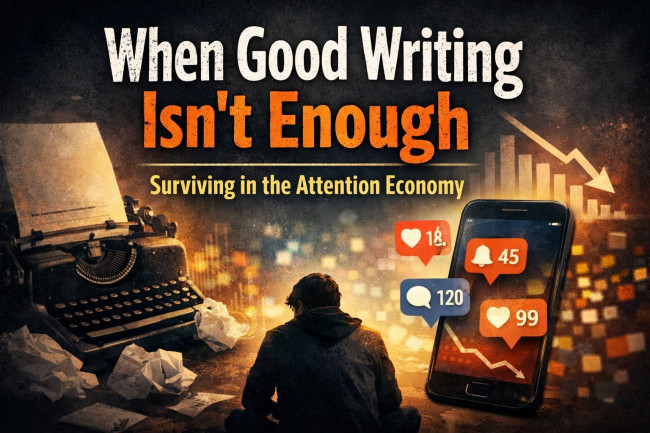
If you are a writer reading this, you have probably experienced a quiet, disorienting moment.
You publish something strong. Structurally sound. Carefully argued. Stylistically clean. Maybe even original. You know, with uncomfortable certainty, that the piece is good.
And nothing happens.
No meaningful readership. No organic discovery. No sustained engagement. Sometimes not even measurable visibility.
Meanwhile, weaker writing spreads widely. Thin summaries outrank deep reporting. Generic listicles circulate faster than essays that took weeks to craft.
This is not an illusion. And it is not simply unfair. It is structural.
The digital ecosystem no longer rewards writing quality in isolation. Craft still matters, but it no longer guarantees reach, influence, or even survival. The belief that quality naturally rises is one of the most persistent myths writers carry into modern publishing.
To understand why good writing isn’t enough today, we have to examine what actually changed.
The Collapse of the “Quality Rises Naturally” Myth
For centuries, writers lived inside slower distribution systems. Newspapers had editors. Publishing houses had gatekeepers. Literary reputation developed over time. Discovery was limited but stable.
In that environment, quality often did correlate with visibility because:
● Fewer people could publish
● Distribution channels were controlled
● Editorial filtering reduced noise
● Readers relied on institutional trust
Even early internet blogging preserved some of this structure. Search engines ranked pages primarily through links and relevance. Thoughtful long-form writing could steadily accumulate readership.
That ecosystem no longer exists.
Today, publishing is frictionless. Anyone can release content instantly across multiple platforms. Volume has exploded beyond any reader’s ability to evaluate quality directly.
When supply becomes effectively infinite, visibility stops being a function of merit alone. It becomes a function of signal amplification.
Quality does not rise. It competes for oxygen.
This is the central reason why quality content fails online. Not because readers reject it, but because they often never encounter it in the first place.
Algorithms Became the Primary Editors
Modern visibility is governed less by human judgment and more by computational filtering.
Search engines, social platforms, and recommendation systems now function as the largest editorial institutions in history. They decide what appears, what spreads, and what disappears.
These systems optimize for measurable engagement signals:
1. Click-through rates
2. Watch time
3. Share velocity
4. Session retention
5. Interaction density
None of these metrics directly measure writing quality.
They measure behavioral response.
This distinction matters deeply for attention economy writing. A piece can be intellectually rigorous yet behaviorally quiet. It may provoke reflection rather than immediate reaction. It may require sustained attention rather than fast emotional triggers.
Algorithms struggle to detect that value.
Consider the shift in search engine ranking over the past decade. Modern search results increasingly favor:
1. Domain authority
2. Topical clustering
3. Content freshness
4. User engagement patterns
5. Structured optimization signals
A brilliant standalone article published on an unknown site can be algorithmically invisible regardless of craft.
Similarly, social feeds prioritize content that generates rapid interaction. Writing designed for contemplation competes poorly against writing designed for stimulation.
Algorithms are not hostile to quality. They are indifferent to it unless quality produces measurable engagement quickly enough.
This makes distribution architecture inseparable from writing success.
Volume Has Redefined the Competitive Field
The scale of content production has expanded beyond historical precedent.
Professional media organizations publish continuously. Independent creators produce daily. AI-assisted writing tools accelerate output dramatically. Entire content farms generate industrial volumes of material optimized for search capture.
The result is not simply more content. It is persistent content pressure.
In earlier eras, a strong article could occupy attention space for days or weeks. Now it may compete with hundreds of new pieces released within hours targeting the same topic, keyword, or audience.
Volume changes reader perception in subtle ways:
1. Individual pieces feel less significant
2. Readers expect faster consumption cycles
3. Novelty becomes more valuable than depth
4. Replacement is immediate
Even exceptional work becomes one item in an endless stream.
This is another reason good writing isn’t enough. Craft competes not only with other writers, but with the velocity of publishing itself.
When supply becomes continuous, attention becomes discontinuous.

Reader Behavior Has Fundamentally Changed
Writers often attribute declining reach to platforms alone, but reader cognition has also evolved.
Digital consumption patterns show consistent shifts:
1. Scanning instead of linear reading
2. Headline filtering before engagement
3. Multi-tab attention fragmentation
4. Preference for summarized information
5. Platform-specific consumption habits
Reading has become situational rather than immersive.
People encounter writing while commuting, switching apps, checking notifications, or managing cognitive overload. Long sustained attention is no longer the default reading posture.
This does not mean readers are incapable of depth. It means depth requires intentional entry rather than passive discovery.
Headline structure, framing, and perceived relevance now function as entry gates. Writing quality becomes visible only after readers choose to invest attention, and that decision happens in milliseconds.
Writers trained to prioritize craft within the text must now also design the conditions of entry.
The Emotional Reality Many Writers Avoid
There is a psychological cost to these structural changes.
Writers are often taught that excellence will eventually be recognized. That patience and craft will accumulate impact over time. That visibility reflects merit.
When reality contradicts this belief, the emotional response can include:
1. Confusion
2. Resentment
3. Self-doubt
4. Withdrawal from publishing
5. Increased perfectionism
The uncomfortable truth is simple: talent without strategic visibility can produce sustained obscurity.
This is difficult to accept because it challenges identity. Writers want to believe that writing alone defines success. Recognizing distribution as equally important can feel like a dilution of artistic integrity.
But ignoring structural conditions does not protect craft. It isolates it.
Understanding why quality content fails online is not an admission of defeat. It is a recognition of the environment in which writing now operates.
When Exceptional Craft Still Breaks Through
Despite these constraints, writing excellence has not lost all power.
Certain conditions still allow exceptional work to gain significant impact:
1. When writing reveals something genuinely new
Original insight still travels. Not novelty for its own sake, but perspective that reorganizes understanding.
2. When writing connects to existing audience infrastructure
Craft amplified by distribution networks can scale rapidly.
3. When writing aligns with moment-specific relevance
Timing can transform visibility. Cultural context functions as an accelerant.
4. When writing produces emotional or intellectual intensity
Deep resonance can generate sharing independent of optimization.
5. When writing accumulates over time
Consistent excellence builds slow authority even without early viral visibility.
The key insight is that craft now requires alignment with structural pathways to produce large-scale reach.
Quality alone does not trigger amplification. Quality plus context can.
Past Discoverability vs Present Discoverability
A useful contrast clarifies the magnitude of change.
Earlier digital publishing:
1. Fewer competing voices
2. Slower publishing cycles
3. Link-based discovery growth
4. Topic authority developed gradually
5. Reader loyalty relatively stable
Current digital publishing:
1. Massive content saturation
2. Continuous real-time publishing
3. Algorithmic filtering layers
4. Platform fragmentation
5. Rapid audience movement
Discoverability shifted from accumulation to competition.
Writers are no longer building visibility inside expanding space. They are competing inside a crowded space that constantly refreshes.
How Can We Improve Writing in This Environment?
Improving writing today means expanding what we consider part of writing practice. Craft still matters deeply, but craft must interact with attention dynamics.
Practical adjustments include:
1. Design for entry, not just depth
The opening structure, framing, and relevance signals determine whether readers reach the writing itself.
2. Develop topical positioning
Specialization increases authority signals and improves algorithmic recognition.
3. Build distribution intentionally
Publishing location, platform alignment, and audience pathways are structural decisions, not afterthoughts.
4. Understand reader context
Writing for mobile reading differs from writing for newsletter subscribers or academic audiences.
5. Produce insight density
Readers facing information overload reward writing that delivers meaning efficiently without superficiality.
6. Maintain conceptual originality
Derivative writing disappears quickly in high-volume environments.
7. Sustain consistency
Visibility often accumulates from repeated exposure rather than single breakthroughs.
Notice what is absent here. None of these recommendations replace craft. They extend it into environmental awareness.
What Writers Must Accept
The modern ecosystem does not operate according to literary fairness. It operates according to attention economics.
This means accepting several difficult realities:
1. Visibility is engineered, not automatic
2. Distribution is a core writing skill
3. Authority influences interpretation
4. Reader behavior shapes form
5. Volume permanently affects perception
Resisting these realities does not preserve writing purity. It reduces impact.
Does Writing Excellence Still Have a Future?
Yes, but not in the form many writers were taught to expect.
Writing excellence still matters because meaning still matters. Interpretation still matters. Insight still matters. Human cognition still depends on structured language to process complex reality.
But excellence now operates under conditions of selective visibility.
It thrives when:
1. Supported by distribution infrastructure
2. Anchored in credible authority
3. Positioned within identifiable niches
4. Delivered with structural awareness
5. Sustained over time
Craft is no longer the entire engine. It is the core component inside a larger system.
The Hard Conclusion
Good writing isn’t enough. Not because writing lost value, but because the environment surrounding writing transformed.
The attention economy rewards signal strength, structural positioning, and behavioral response alongside craft. Writers who ignore this reality risk invisibility regardless of talent.
Yet writing excellence has not become obsolete. It has become conditional.
The future belongs to writers who understand both language and attention. Both meaning and distribution. Both insight and infrastructure.
The page is still where ideas live.
But the path that leads readers to that page is now part of the writing itself.








Comments