
Electric vehicles make it easy to obsess over one number: range. But anyone who’s lived with an EV for even a week knows range isn’t a fixed promise, it’s a result. Speed, temperature, terrain, tires, and driving style all matter.
So where do driving modes fit in?
If you’re wondering whether the Cadillac LYRIQ delivers different range depending on Tour, Sport, Snow/Ice, or My Mode, the honest answer is:
Driving modes don’t change the battery’s size or “official” EPA range—but they absolutely can change how quickly the vehicle uses energy in real-world driving.
This article breaks down what each mode changes, why that affects energy use, and how to choose the right mode for your situation with practical examples and myths cleared up along the way.
What “Driving Modes” Mean in an EV
In an EV like the Lyriq, driving modes are software‑defined profiles that adjust how the car responds to your inputs and road conditions without changing the physical battery pack. Under the skin, you still have the same high‑voltage battery, inverters, and motors, but the control software can:
● Change accelerator pedal mapping (how much torque you get for a given pedal position).
● Adjust steering weight and sometimes suspension feel, where equipped.
● Alter traction and stability control thresholds, especially in low‑grip conditions.
● Influence how assertively the car uses regenerative braking versus friction brakes in some scenarios.
Because power = energy / time, a mode that encourages sharper acceleration and higher average speeds will typically consume more energy per mile, while a calmer, smoother map makes it easier to drive efficiently even if the official EPA range number doesn’t change on paper.
The LYRIQ’s Driving Modes: What Each One Is For
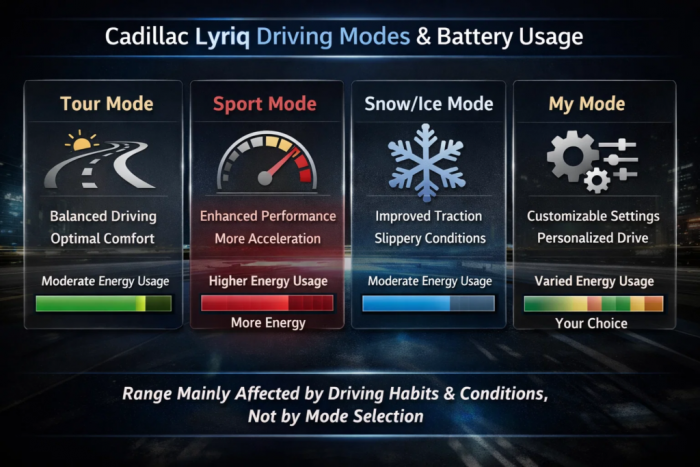
Cadillac’s official language centers on tailoring performance and handling to conditions and preference, but owners and testers consistently see range differences between modes in similar routes.
1. Tour Mode (default “everyday” mode)
Tour is the Lyriq’s primary, balanced setting and the one the vehicle defaults back to after shutdown if you were in certain other modes.
● Purpose: Daily driving and long‑distance cruising, with a focus on comfort and efficiency.
● Behavior: Smooth, progressive throttle map, moderate steering weight, calm power delivery that avoids sudden surges unless you push deep into the pedal.
● Efficiency: Multiple independent guides describe Tour as the best mode for maximizing real‑world range because it naturally tempers aggressive accelerations.
2. Sport Mode
Sport exists to make the Lyriq feel more like a performance EV—even though the hardware is unchanged.
● Purpose: More responsive, engaging driving with sharper reactions.
● Behavior: Quicker pedal response, firmer steering feel, more immediate torque delivery.
● Efficiency: Because it makes it easy to use more power more often, Sport tends to reduce effective range versus Tour; several owner‑oriented guides estimate roughly 8–15% higher consumption when driven in the same conditions but with a heavier right foot encouraged by the sharper map.
3. Snow/Ice Mode
Snow/Ice is focused on traction and stability, not on raw range numbers.
● Purpose: Winter conditions—snow, slush, or ice, where smooth torque delivery helps prevent wheelspin.
● Behavior: Very conservative pedal map, reduced initial torque, traction and stability systems tuned to intervene earlier, often with softer responses.
● Efficiency: On genuinely slippery roads, this can actually help avoid wasteful wheelspin and maintain control, but on dry pavement Snow/Ice can slightly reduce range because it isn’t optimized for efficient cruising and may keep power delivery and traction systems busier than necessary.
4. My Mode (customizable)
My Mode lets you “build your own” profile by mixing different feels for acceleration, braking, steering, and even motor sound.
● Purpose: Personalization—balancing comfort, performance, and efficiency according to your preference.
● Behavior: You can typically choose between relaxed, Tour, or Sport‑like acceleration feels, adjust steering weight, and select different brake feel and synthesized motor sound levels where supported.
● Efficiency: If you configure My Mode with a relaxed or Tour‑like accelerator feel and pair it with strong regenerative braking and efficient HVAC settings, some owner‑level analyses suggest you can match or even slightly beat Tour in efficiency (on the order of up to 10–15% better than an aggressively driven Sport profile in similar conditions).
How the modes change battery usage
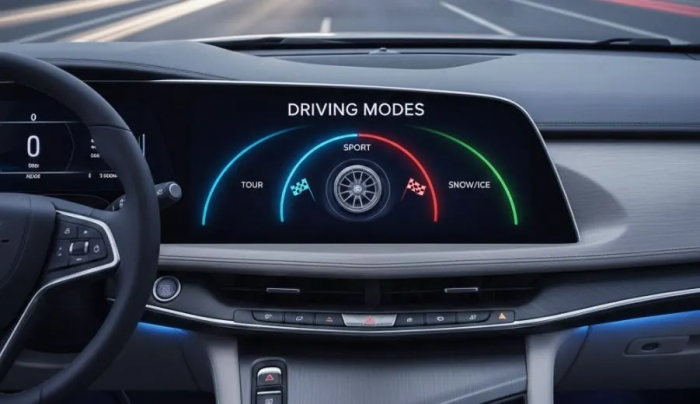
The Lyriq’s EPA estimates (for example, up to around 326 miles for certain RWD trims and about 319 miles for some AWD configurations) are measured under standardized test conditions and don’t explicitly call out drive mode. However, in real‑world mixed driving, battery usage per mile shifts with mode‑driven behavior.
Key levers that affect energy per mile
● Throttle mapping: Sport’s immediate torque leads to more frequent high‑power bursts; Tour smooths these out, lowering peaks and improving kWh per mile.
● Traction and stability intervention: Snow/Ice prioritizes grip and safety, which can slightly increase energy use on dry roads but can prevent wasteful wheelspin in winter.
● Driver psychology: Because Sport “feels” faster and more responsive, drivers tend to accelerate harder, hold higher speeds, and brake later—all behaviors that reduce range regardless of any mechanical differences.
Several owner‑oriented breakdowns of Lyriq drive modes converge on these approximate real‑world deltas under similar routes and climates:
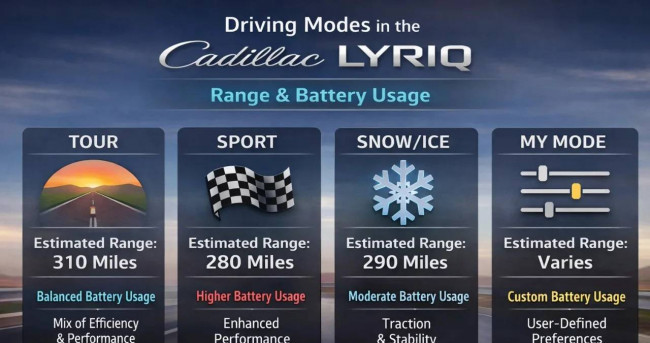
● Tour vs Sport: Tour can deliver around 8–10% better efficiency than Sport if you drive them in a comparable way, translating to roughly 25–30 extra miles on a ~312–320‑mile baseline.
● Efficient custom My Mode vs aggressive Sport: Tuned for efficiency (relaxed acceleration, strong regen, eco HVAC), My Mode plus careful driving can gain up to roughly 10–15% over a spirited Sport drive, equating to roughly 50–70 miles difference at the extremes according to some long‑trip logs and analyses.
These are not official Cadillac figures but give a realistic sense of what Lyriq owners and reviewers see when they treat modes differently on the same car.
Regenerative braking’s role in range
Regenerative braking (regen) is the silent partner in the drive‑mode story because it helps claw back energy you’d otherwise waste as heat in the friction brakes.
How regen works in the Lyriq
When you lift off the accelerator or pull the “Regen on Demand” paddle, the drive motor runs in generator mode, converting the vehicle’s kinetic energy into electrical energy and sending it back into the battery. The Lyriq gives you two main regen tools:
● One‑Pedal Driving: When enabled, lifting off the accelerator automatically slows the car significantly, often down to a stop, via regen alone in many everyday situations.
● Variable “Regen on Demand” paddle: A pressure‑sensitive paddle behind the steering wheel lets you add regen manually; the harder you pull, the stronger the deceleration and energy recovery, up to the point the vehicle can come to a complete stop while the paddle is held.
Using both together, One‑Pedal for default slowing and the paddle to fine‑tune deceleration can maximize the share of braking handled electrically instead of via the pads, improving overall efficiency especially in stop‑and‑go or hilly environments.
Interaction with modes
While regen features are not “locked” to a particular drive mode, efficient presets and smoother accelerator maps (Tour, efficient My Mode) make it easier to coast and plan your deceleration, which lets regen do more of the work.
● In gentle driving with strong regen engaged, you recapture more energy and see better kWh per mile, regardless of whether you’re technically in Tour or a mellow My Mode.
● In aggressive Sport driving with frequent hard braking, friction brakes are called in more often and regen’s contribution to overall energy recovered drops.
Real‑world scenarios
Here are some concrete, Lyriq‑specific scenarios that illustrate how modes and regen settings play out in actual driving.
Scenario 1: 60‑mile daily commute (mixed highway/city)
● Setup: RWD Lyriq, mostly highway at 65–70 mph with some urban sections.
● Mode choice: Tour, One‑Pedal Driving on in town, Regen on Demand used sparingly to smooth out higher‑speed exits.
● Result pattern: Consistent owners’ reports and guides suggest Tour plus disciplined speeds and strong regen can deliver near‑EPA efficiency or slightly better in mild weather, turning a nominal 320‑mile pack into a realistic 280–310‑mile usable range on many days.
If you repeat the same commute in Sport while enjoying quicker bursts up to speed and more lane‑change sprints, you may see that drop by around 8–12%, meaning perhaps 250–280 realistic miles in similar climate and traffic.
Scenario 2: Cold‑weather highway trip with Snow/Ice
● Setup: AWD Lyriq, sub‑freezing temps, light snow on the highway, 200‑mile leg.
● Mode choice: Snow/Ice engaged for much of the drive to tame torque and improve confidence, One‑Pedal used in slower sections, with HVAC working harder to keep the cabin warm.
● Result pattern: In these conditions, your range is already reduced by the cold battery and cabin heating load; Snow/Ice’s conservative torque helps avoid wasteful wheelspin, but its safety‑first calibration and frequent traction interventions can still mean somewhat higher consumption versus Tour in dry weather. Many EV drivers plan a winter buffer of 15–30% less range compared with mild conditions, with mode choice being just one lever among several.
Scenario 3: Urban stop‑and‑go with My Mode + One‑Pedal
● Setup: Inner‑city errands, primarily 0–45 mph with frequent traffic lights.
● Mode choice: My Mode set to relaxed acceleration, normal steering, firm regenerative “feel,” One‑Pedal on, Regen on Demand paddle used occasionally for extra slowing into tight parking spots.
● Result pattern: Here, regen has the biggest upside because every deceleration is an opportunity to recapture energy. Some real‑world logs and analyses indicate that a carefully driven My Mode with strong regen in these conditions can match or slightly beat Tour’s efficiency and outperform an aggressively used Sport by double‑digit percentages over a full charge.
Scenario 4: Mountain descent
● Setup: Long downhill grade after a climb, mixed curves.
● Mode choice: Tour or My Mode with strong regen and One‑Pedal enabled, driver uses Regen on Demand heavily instead of riding the brakes.
● Result pattern: The battery recovers noticeable energy on the descent (sometimes several kWh), visible as added range on the display, which partially offsets the energy spent climbing. Here, your technique (planning speed, using regen) matters more than whether you’re in Tour versus My Mode with similar regen settings.
Myths and misunderstandings about Lyriq drive modes
A few persistent misconceptions can lead owners to misjudge what the modes can actually do.
● “Sport mode unlocks extra battery power I can’t use elsewhere.”
The maximum power capability of the pack and motors is the same; Sport just makes it easier to reach that power quickly with smaller pedal movements.
● “Snow/Ice is a hidden eco mode because it feels slower.”
Snow/Ice primarily manages traction; it can slightly hurt range on dry roads versus Tour because it’s tuned for safety, not battery efficiency, although it prevents wasteful wheelspin on slick surfaces.
● “My Mode is only for comfort and sound.”
In reality, My Mode can be configured to be one of the most efficiency‑oriented options by pairing a relaxed acceleration profile with strong regen and calmer cabin settings, making it a powerful tool for range‑focused drivers.
● “Drive mode alone dictates my range.”
Mode is a meaningful lever, but speed, temperature, tire pressure, payload, HVAC use, and driving style typically have a bigger absolute effect.
How Lyriq modes compare to other EVs
The Lyriq’s mode strategy is broadly similar to other modern EVs but with Cadillac‑specific tuning and a strong emphasis on variable regen controls.
● Tesla: Uses Chill, Standard, and sometimes Sport/Track modes; Chill is analogous to Tour (gentler throttle), while Sport/Track behave like or beyond Lyriq’s Sport, with similar trade‑offs in consumption.
● Hyundai/Kia (E‑GMP): Offer Eco, Normal, Sport; Eco is explicitly range‑oriented, limiting power and sometimes HVAC, while Sport behaves like Lyriq’s Sport.
● VW ID.‑family: Provides Eco, Comfort, Sport; Eco can limit top speed and throttle response more aggressively than Lyriq’s Tour, making Cadillac’s approach feel more “luxury‑balanced” than purely utilitarian.
Where the Lyriq stands out is the combination of robust One‑Pedal Driving with a pressure‑sensitive Regen on Demand paddle, giving drivers fine‑grained control of braking energy recovery in any mode, whereas some rivals rely solely on fixed regen levels or simple paddles without such dynamic range.
Tips to maximize range in any mode
Regardless of which mode you prefer, you can apply a few consistent habits to stretch your Lyriq’s battery further.
● Use One‑Pedal Driving in city traffic. This increases the proportion of your braking done through regen, especially at lower speeds where energy recovery is most effective.
● Learn the Regen on Demand paddle. Practice modulating it on downhills and approach to lights so you rely less on friction brakes.
● Keep acceleration smooth, even in Sport. If you like Sport’s steering and responsiveness, you can still accelerate progressively and keep speeds moderate to limit the efficiency penalty.
● Watch your speed on highways. Above roughly 65–70 mph, aerodynamic drag grows quickly, increasing consumption more than mode alone.
● Precondition the cabin and battery while plugged in. Warming or cooling the cabin and, where available, the battery before unplugging reduces on‑road HVAC loads.
● Use Snow/Ice only when needed. Switch back to Tour or an efficient My Mode on dry roads to avoid unnecessary traction‑control overhead.
● Maintain tires and alignment. Proper tire pressures and alignment help keep rolling resistance in check, supporting better kWh per mile.
Bottom line
The Cadillac Lyriq’s driving modes do not change the size or chemistry of your battery, but they absolutely influence how much of that stored energy you use per mile by shaping throttle behavior, traction responses, and how naturally you fall into efficient or inefficient habits. For most owners, Tour (or an efficiency‑oriented My Mode) paired with strong regenerative braking and smooth driving delivers the best real‑world range, while Sport trades a noticeable chunk of that range for sharper performance and Snow/Ice prioritizes security on slippery roads over outright efficiency.









Comments