
AI marketing is no longer experimental. It writes emails, predicts customer behavior, builds audiences, optimizes ads, and personalizes websites in real time. Yet despite its widespread use, many businesses still operate under outdated assumptions about what AI can and cannot do.
As we move deeper into 2026, it is time to retire the myths that quietly limit strategy, creativity, and growth. Here are six common AI marketing myths that deserve to be left behind.
1. Myth: AI Replaces Marketers
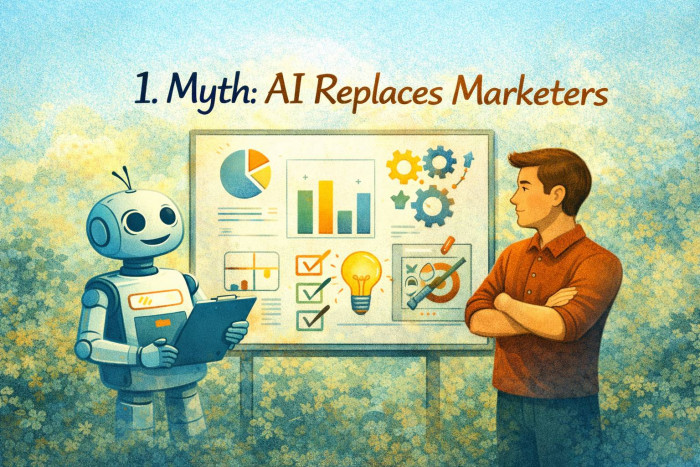
One of the biggest fears surrounding AI is that it will eliminate marketing jobs. In reality, AI replaces repetitive tasks, not strategic thinking.
AI can generate content drafts quickly, analyze large volumes of campaign data in seconds, segment audiences automatically based on behavior, and optimize ad bidding more efficiently than manual methods.
However, AI cannot deeply understand brand nuance, build a long-term creative vision, lead emotional storytelling with cultural sensitivity, or navigate complex human decisions that require judgment and empathy.
The strongest marketing teams in 2026 are not competing with AI. They are collaborating with it. AI handles speed and scale, while humans handle strategy, interpretation, and meaning.
2. Myth: AI Automatically Guarantees Better Results
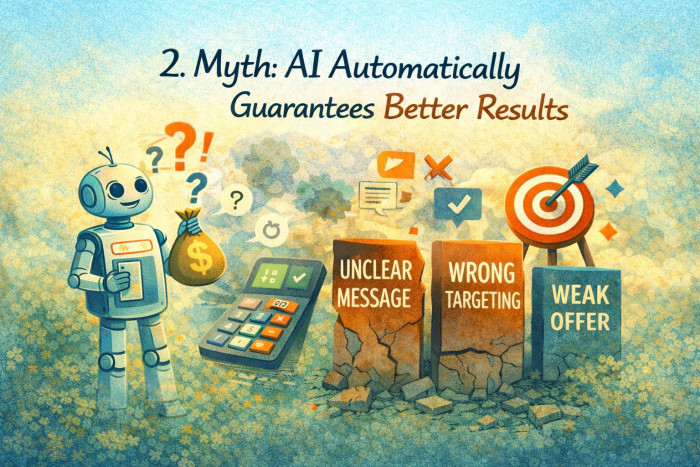
AI is powerful, but it is not magic. Poor strategy combined with AI still produces poor results.
If your messaging is unclear, your offer lacks value, your audience targeting is inaccurate, or your brand positioning lacks clarity, AI will simply optimize a flawed foundation rather than fix it.
AI enhances direction, but it does not create direction. Success still depends on setting clear goals, developing strong positioning, collecting quality data, and committing to consistent testing and refinement.
Without these elements, AI becomes an expensive shortcut to mediocre performance.
3. Myth: AI Marketing Is Only for Big Companies
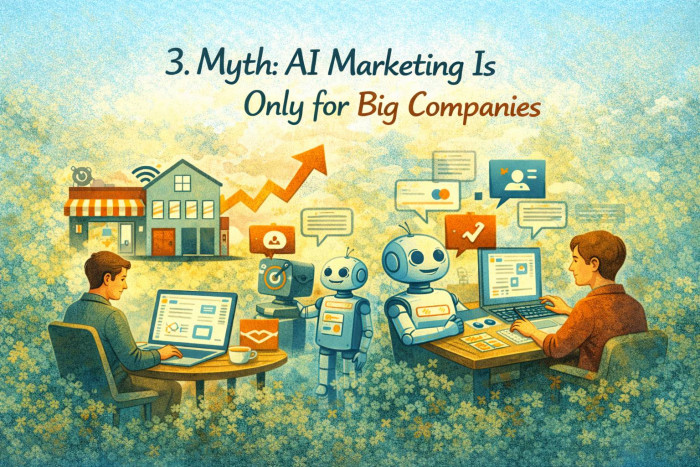
In 2023 and 2024, AI tools were often expensive and designed primarily for enterprise use. By 2025, that barrier has largely disappeared.
Today, small businesses use AI for email automation and customer segmentation, freelancers rely on AI for content creation and idea generation, startups implement AI chatbots to improve customer support, and local brands use AI-powered analytics dashboards to track performance.
The real divide is no longer budget. It is understanding. Businesses that learn how to apply AI strategically can gain leverage regardless of their size.
4. Myth: AI Content Feels Robotic and Inauthentic
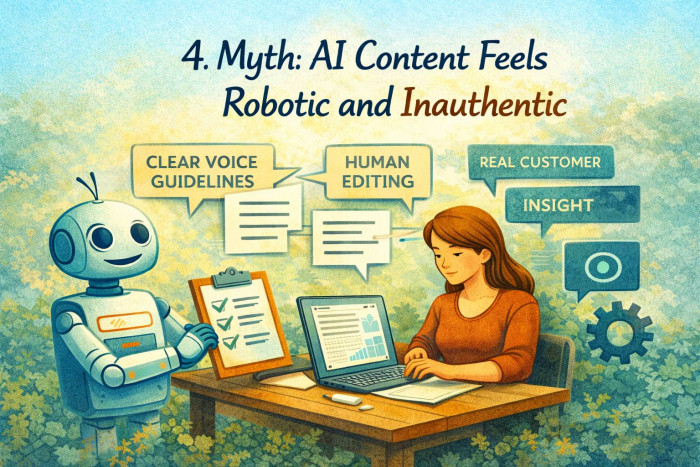
Early AI-generated content often felt generic, which created a lasting stigma around machine-written material. However, the quality of AI writing, design, and personalization has improved significantly.
Authenticity does not come from AI alone. It comes from clear brand voice guidelines, careful human editing, real customer insight, and a unique perspective that differentiates a brand from competitors.
AI serves as a tool for drafting, scaling, and testing variations. When guided properly, it enhances brand voice rather than replacing it. Unsupervised AI may sound generic, but strategically directed AI can sound consistent, polished, and aligned with brand identity.
5. Myth: AI Removes the Need for Creativity
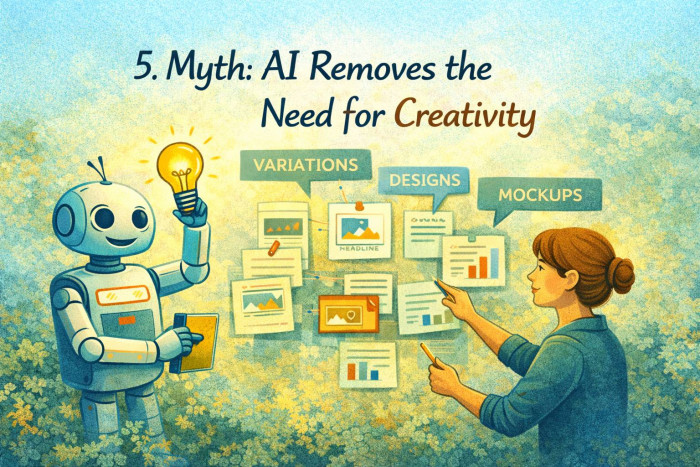
Some marketers assume AI reduces creativity because it relies on analyzing existing data patterns. In truth, AI can expand creative exploration by removing production bottlenecks.
AI allows teams to run rapid A/B tests on creative concepts, generate multiple headline variations in seconds, analyze emerging trends through predictive insights, and create visual mockups without long production cycles.
This efficiency frees creative teams to focus on higher-level ideas rather than repetitive execution tasks. Instead of spending hours developing one concept, they can experiment with multiple approaches and refine based on data. Creativity becomes more iterative, informed, and less risky.
The future of marketing creativity is not human versus machine. It is human imagination amplified by machine efficiency.
6. Myth: AI Marketing Is Fully Automated
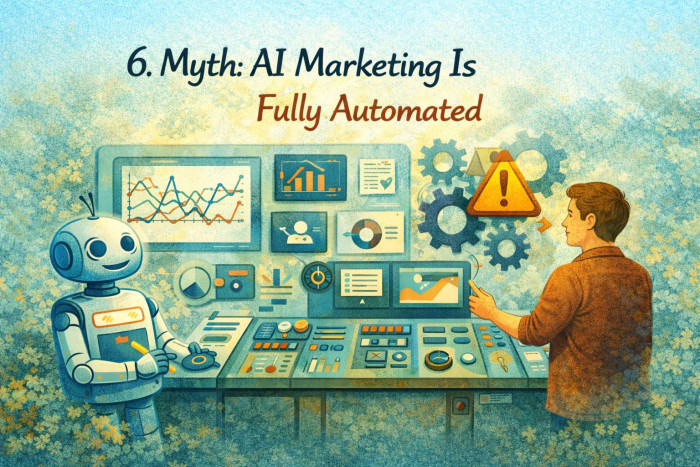
There is a persistent belief that AI marketing systems can run on autopilot once they are set up. In reality, AI requires continuous oversight.
Algorithms shift frequently, consumer behavior evolves rapidly, digital platforms update their policies regularly, and market conditions change unpredictably.
AI systems must be monitored, refined, and adjusted over time. Data needs interpretation, outputs require review, and strategic direction must evolve alongside external changes.
The most successful AI-driven campaigns are not fully automated. They are intelligently supervised and strategically guided.
Why These Myths Persist
These misconceptions often arise from two extremes. On one side, overhype promised instant transformation and effortless growth. On the other side, fear-based narratives predicted widespread job loss and loss of control.
The truth lies in balance. AI is neither a miracle nor a threat. It is an amplifier that magnifies strengths and weaknesses alike.
Businesses that cling to outdated assumptions risk either underusing AI or misusing it entirely.
The Smarter Approach to AI Marketing in 2026
Instead of asking whether AI will replace marketing professionals, smarter questions include:
- How does AI create meaningful leverage within our existing workflow?
- Which repetitive tasks can we automate responsibly without sacrificing quality?
- How can we protect and strengthen our brand voice while scaling output?
- Which decisions still require human judgment, creativity, and ethical oversight?
AI works best when integrated thoughtfully into established systems rather than adopted impulsively as a trend.
Final Thoughts
AI marketing in 2025 is no longer about novelty. It is about refinement. The companies that thrive are not those chasing every new AI tool, but those who understand both its strengths and its limits.
It is time to leave behind the myths that AI replaces humans, guarantees success, belongs only to big brands, destroys authenticity, eliminates creativity, or runs entirely on its own.
The future of marketing belongs to those who combine human insight with intelligent automation.
AI is not the marketer.
You are.

Comments