
Tools That Compete on the Same Battlefield
Copy.ai
Copy.ai operates as a high-volume content generation engine rather than an SEO-first platform. It focuses heavily on short-form outputs like ads, product descriptions, cold emails, and social copy. Compared to Writesonic, it sacrifices structured SEO workflows but delivers faster iteration speed. (https://www.copy.ai/)
The tool is best suited for marketing teams that need to produce variations at scale. For example, generating 20 Facebook ad variants or multiple landing page hooks is faster and more consistent in Copy.ai than Writesonic. However, when you move into blog writing or SEO articles, Writesonic still holds an edge due to its structured approach.
Feature reality shows that Copy.ai is template-heavy. While it offers over 90 tools, most outputs depend on predefined formats. This speeds up production but limits flexibility when you need nuanced or long-form content.
Pricing Breakdown
| Plan | Price (Monthly) | Key Limits |
| Free | $0 | Limited credits, basic tools |
| Pro | ~$49/month | Unlimited words, priority support |
Ratings Snapshot
| Platform | Rating |
| G2 | ~4.7/5 |
| Capterra | ~4.5/5 |
| Trustpilot | ~3.9/5 |
Verdict
Replace Writesonic if you need faster short-form content at scale.
Avoid if your workflow depends on structured SEO articles.
Rytr
Rytr positions itself as the budget-first alternative in this category. It is not trying to outperform Writesonic on depth or SEO but on affordability and simplicity. (https://rytr.me/)
It works best for freelancers, solo creators, or small businesses that need consistent but not highly complex outputs. At around $9 per month for the Saver plan, it is significantly cheaper than Writesonic. However, that lower cost reflects in output quality, especially for long-form content.

Where Rytr beats Writesonic is cost efficiency. For repetitive tasks like product descriptions or basic blog outlines, it delivers acceptable quality without requiring a higher subscription. Where it fails is in depth. Outputs often need manual rewriting, and tone consistency can vary.
The feature reality is straightforward. Rytr has fewer templates and less workflow depth, which makes it easier to use but also limits scalability for teams.
Pricing Breakdown
| Plan | Price (Monthly) | Key Limits |
| Free | $0 | Limited characters |
| Saver | ~$9/month | 100k characters |
| Unlimited | ~$29/month | Unlimited generation |
Ratings Snapshot
| Platform | Rating |
| G2 | ~4.7/5 |
| Capterra | ~4.6/5 |
| Trustpilot | ~4.3/5 |
Verdict
Replace Writesonic if budget is the primary constraint.
Avoid if you need consistent long-form quality.
Anyword
Anyword operates differently from most tools in this list. It is built for performance-driven copywriting, especially ads and conversion-focused content. Instead of just generating text, it predicts performance scores based on historical data. (https://www.anyword.com/)
This makes it highly relevant for performance marketers running paid campaigns. Compared to Writesonic, Anyword produces fewer variations but with more intent behind each output. For example, ad copy comes with predictive scoring, which reduces testing cycles.

Where it beats Writesonic is in conversion-focused workflows. Where it fails is pricing and flexibility. Starting around $49 per month and scaling quickly, it is one of the more expensive tools in this category.
Feature reality shows that Anyword is not designed for general content creation. Blog writing and SEO workflows are weaker than those of Writesonic or Scalenut.
Pricing Breakdown
| Plan | Price (Monthly) | Key Limits |
| Starter | ~$49/month | Limited credits, basic scoring |
| Data-Driven | ~$99/month | Advanced analytics, higher limits |
Ratings Snapshot
| Platform | Rating |
| G2 | ~4.8/5 |
| Capterra | ~4.5/5 |
| Trustpilot | Not listed |
Verdict
Replace Writesonic if your focus is ad performance and conversion.
Avoid if you need broad content generation.
Scalenut
Scalenut is the closest direct competitor to Writesonic in terms of SEO-first workflows. It combines keyword research, content briefs, and AI writing into a single pipeline.
For users creating blog content at scale, Scalenut often outperforms Writesonic in structure and optimization. It provides better topic clustering and content planning features, which matter for long-term SEO strategies. (https://www.scalenut.com/)
However, Scalenut is more rigid. The workflow is structured, which helps beginners but can slow down experienced users who want flexibility. Writesonic allows more free-form generation, which some users prefer.

Feature reality shows that Scalenut is stronger in planning but slightly slower in execution. It is not ideal for quick copy generation.
Pricing Breakdown
| Plan | Price (Monthly) | Key Limits |
| Essential | ~$39/month | Limited SEO docs |
| Growth | ~$79/month | Higher content limits |
Ratings Snapshot
| Platform | Rating |
| G2 | ~4.7/5 |
| Capterra | ~4.6/5 |
| Trustpilot | ~4.2/5 |
Verdict
Replace Writesonic if SEO workflows are your priority.
Avoid if you want fast, flexible content generation.
Copysmith
Copysmith focuses heavily on eCommerce content generation, particularly bulk product descriptions and catalog-based workflows. (https://www.copysmith.ai/)
For businesses managing large inventories, it performs better than Writesonic because it allows structured bulk generation tied to product data. However, outside eCommerce, it feels limited.
Where it beats Writesonic is in bulk generation. Where it fails is versatility. It is not built for blogs, ads, and SEO workflows in the same balanced way.
Feature reality shows strong integration capabilities but narrower use cases.
Pricing Breakdown
| Plan | Price (Monthly) | Key Limits |
| Starter | ~$19/month | Limited credits |
| Professional | ~$59/month | Bulk generation, integrations |
Ratings Snapshot
| Platform | Rating |
| G2 | ~4.3/5 |
| Capterra | ~4.4/5 |
| Trustpilot | Not listed |
Verdict
Replace Writesonic if you run eCommerce at scale.
Avoid if you need multi-purpose content generation.
Side-by-Side Comparison That Actually Matters
| Tool | Starting Price | Best For | Weakness | Rating Avg |
| Copy.ai | $49 | Short-form scale | Weak SEO workflows | ~4.6 |
| Rytr | $9 | Budget usage | Lower output depth | ~4.6 |
| Anyword | $49 | Ad performance | Expensive, narrow use | ~4.6 |
| Scalenut | $39 | SEO content | Slower workflow | ~4.7 |
| Copysmith | $19 | eCommerce bulk | Limited versatility | ~4.3 |
Pricing vs Value Curve
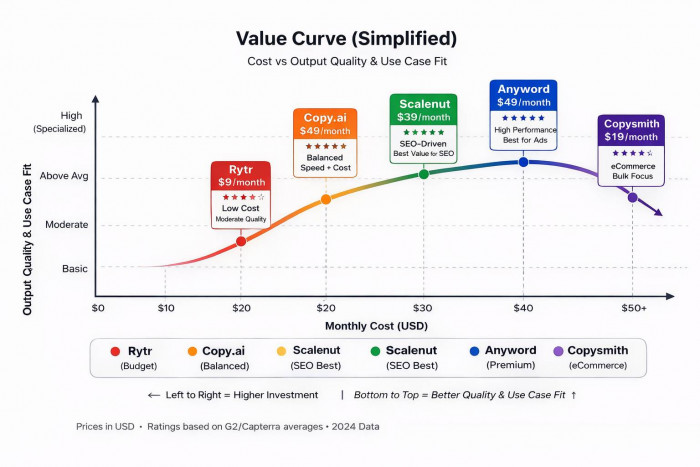
If you are evaluating purely on cost, Rytr is the cheapest entry point. But cost alone does not translate into value. The real metric is how much usable output you get without rewriting.
Copy.ai sits in the middle where pricing is higher than Rytr but justified by speed and scalability. Scalenut offers strong value for SEO-focused users because it reduces the need for separate keyword tools.
Anyword is expensive but justified if you are spending on ads. A single high-performing ad can offset the subscription cost.
What People Don’t Tell You About These Tools
Most tools in this category rely heavily on templates. This creates a pattern where outputs feel similar after repeated use. It is noticeable in Copy.ai and Rytr where repeated prompts produce structurally similar responses.
Editing effort is another hidden cost. Even high-rated tools like Anyword or Scalenut require human refinement. Review trends across G2 and Capterra consistently highlight that AI-generated content often needs tone adjustment and factual correction.
There is also a dependency issue. Once workflows are built around a tool’s templates or SEO pipeline, switching becomes harder. For example, moving from Scalenut to another platform can disrupt content planning systems.
Final Call: Which One Replaces Writesonic (Based on Use Case)
- For budget users, Rytr is the most practical replacement. It reduces cost significantly while maintaining acceptable output for basic use cases.
- If you are performance marketers, Anyword is the strongest alternative. It does not replace Writesonic directly but improves conversion-driven workflows where Writesonic lacks depth.
- For content-heavy workflows, Scalenut is the closest replacement. It matches and often exceeds Writesonic in SEO-driven content production, especially for long-form articles.
- If your workflow is centered around high-volume short-form content, Copy.ai becomes the better choice due to speed and iteration capability.
The right replacement depends less on features and more on what part of Writesonic you actually use.




Comments