
Not long ago, content teams worked mostly by hand. Writers drafted everything from scratch, editors reviewed line by line, and social media managers manually scheduled every post. Today, the landscape looks very different.
AI tools have quietly become part of everyday workflows. From brainstorming blog topics to generating captions and analyzing SEO performance, AI is helping teams move faster and work smarter. But it has not replaced humans. Instead, it is reshaping how modern content teams operate.
Let’s break down what that actually looks like.
What a Modern Content Team Looks Like Today
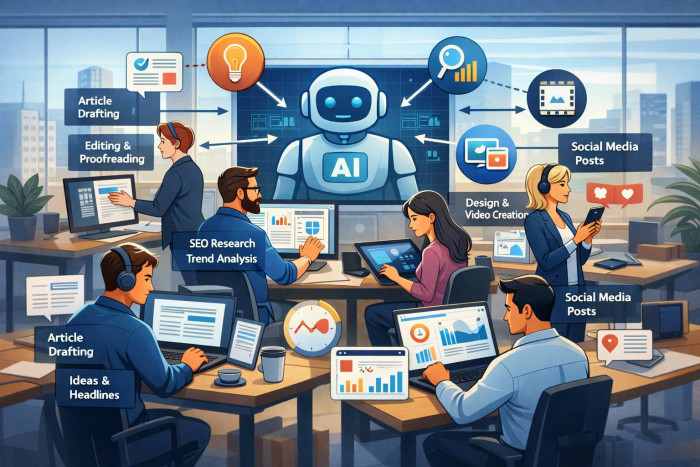
A typical content team is no longer just a writer and an editor. Most teams now include a mix of specialized roles working together.
Common roles in modern content teams:
1. Writers and copywriters
2. Editors and proofreaders
3. Content strategists and SEO specialists
4. Designers and video creators
5. Social media managers
6. Marketing and analytics teams
Each role has its own responsibilities, and AI tools are now supporting nearly all of them in different ways.
How AI Is Used Today
Writers were among the first to adopt AI tools, mainly because writing involves many repetitive steps.
How Writers Use AI-
Writers use AI for:
1. Brainstorming content ideas
2. Creating outlines
3. Drafting first versions
4. Rewriting and simplifying text
5. Generating headline options
6. Fixing grammar and clarity
In practice:
Most writers do not publish AI output as-is. Instead, they use AI to speed up the early stages and then add their own voice, expertise, and examples.
Think of AI as a fast research assistant, not the final author.
How Editors Use AI-
Editors still play a critical role in maintaining quality. AI helps them work faster but does not replace their judgment.
Editors commonly use AI for:
1. Proofreading and grammar checks
2. Readability improvements
3. Tone consistency checks
4. Basic fact cross-checking
5. Style suggestions
Where humans still matter most:
1. Nuance and context
2. Brand voice protection
3. Logical flow
4. Final quality control
AI can catch typos quickly, but experienced editors still catch what machines miss.
How Strategists Use AI-
Content strategists care about performance, search demand, and audience behavior. AI has become extremely useful here.
Strategists use AI for:
1. Keyword research assistance
2. Topic clustering
3. Search intent analysis
4. Competitor content summaries
5. Audience trend spotting
6. Content gap analysis
Real-world impact:
Strategists can now plan months of content faster and with better data support than before.
AI helps answer questions like:
1. What should we write next?
2. What topics are trending?
3. Where are we missing opportunities?
How Designers and Video Teams Use AI
Visual teams are seeing some of the biggest productivity gains from AI.
Designers use AI for:
1. Thumbnail generation
2. Background removal
3. Quick social graphics
4. Image variations
5. Basic video edits
Video teams use AI for:
1. Auto captions
2. Clip generation
3. Voiceovers
4. Short-form repurposing
5. Rough cut editing
Important: High-end creative work still relies heavily on human skill, but AI dramatically speeds up the routine parts.
How Social Media Teams Use AI
Social teams move fast, and AI fits naturally into their workflow.
Social media managers use AI for:
1. Caption generation
2. Post variations
3. Hashtag suggestions
4. Content repurposing
5. Scheduling assistance
6. Performance summaries
Typical workflow today:
1. AI drafts caption ideas
2. Human tweaks tone
3. AI suggests posting time
4. Human reviews analytics
This hybrid model is becoming the norm.
Why Content Teams Are Embracing AI
When used correctly, AI brings clear operational benefits.
Key benefits
1. Faster content production
2. More consistent publishing
3. Lower production costs
4. Easier content repurposing
5. Better data-informed decisions
6. Reduced creative burnout
7. Ability to scale output
For lean teams especially, AI can feel like adding an extra junior team member.
The Limitations and Concerns
AI is powerful, but it is not perfect. Smart teams understand the risks.
Common concerns
1. Content can sound generic
2. Risk of factual mistakes
3. Over-reliance can weaken skills
4. Brand voice can become diluted
5. Originality concerns
6. Ethical and copyright questions
Plain truth:
If you let AI do everything, quality usually drops.
The teams that struggle most are the ones that try to fully automate creativity.
How to Use AI Without Losing Your Human Voice
This is the skill that separates average teams from great ones.
Practical tips for writers and teams
Use AI for the heavy lifting, not the final polish
1. Brainstorm with AI
2. Outline with AI
3. Draft with AI
4. But always edit yourself
Always add human layers
1. Personal examples
2. Real opinions
3. Brand tone
4. Industry insights
5. Original angles
This is what makes content feel real.
Create internal AI guidelines
Good teams define:
1. What AI can be used for
2. What must be human-reviewed
3. Voice and tone rules
4. Fact-check requirements
This keeps quality consistent.
Edit ruthlessly
Before publishing, ask:
1. Does this sound like us?
2. Is this too generic?
3. Did we add real value?
4. Would a reader trust this?
If not, revise.
The Big Picture: Where This Is All Heading
AI is not replacing content teams. It is reshaping them.
The modern content team is becoming:
1. Smaller but more productive
2. Faster but still human-led
3. More data-driven
4. More experimental
5. More focused on strategy over manual work
The thoughtful takeaway
AI is best seen as a powerful assistant, not a creative replacement. The teams that win will be the ones that combine:
1. AI speed
2. Human judgment
3. Strong editorial standards
4. Clear brand voice
Used wisely, AI removes the busywork and gives creators more time to do what humans still do best: think, create, and connect with real people.
And that is something no tool has fully automated yet.




Comments