
Why Uncensored AI Writing Platforms Started Appearing
During the early growth of generative AI writing tools, most major platforms adopted strict content moderation rules. Systems such as ChatGPT, Claude, and several enterprise AI writing tools intentionally restricted explicit adult storytelling. These safeguards were implemented to prevent misuse, comply with platform policies, and reduce legal risk.
However, fiction communities online have always included genres that explore adult themes. Romance, dark fantasy, erotic fiction, and roleplay storytelling have existed on forums and fan fiction websites for decades. Writers in these communities often rely on experimentation, improvisation, and highly personalized characters.
When mainstream AI platforms began filtering certain prompts, a new category of tools appeared. These tools marketed themselves as uncensored AI writing assistants or AI smut writers. Their goal was not simply to remove restrictions, but to provide systems optimized for long form storytelling, roleplay conversations, and highly descriptive character interactions.
Many of these platforms emerged from smaller startups or developer communities experimenting with open language models. Others evolved from roleplay chatbot systems originally built for gaming communities.
While the term “AI smut writer” sounds provocative, the actual platforms function much like creative writing assistants. They help generate dialogue, story scenes, character personalities, and narrative expansions. The difference lies primarily in the content boundaries they allow and the writing styles they optimize for.
Across Reddit writing forums, AI creator communities, and fan fiction spaces, these tools quickly gained attention because they solved a practical problem. Writers wanted AI partners that could assist with creative freedom rather than strict moderation filters.
What an AI Smut Writer Tool Actually Is
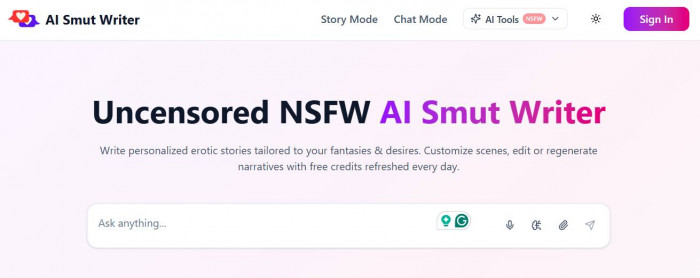
After testing several of these platforms, the core idea becomes clear. An AI smut writer is essentially a specialized AI storytelling engine designed to generate narrative scenes with fewer topic restrictions.
From a technical perspective, most of these tools are built on large language models similar to those used in other AI writing systems. The difference lies in three areas:
• training datasets or fine tuning
• system prompts and moderation rules
• features designed specifically for storytelling
Instead of focusing on marketing copy, SEO articles, or business emails, these systems are structured around narrative generation.
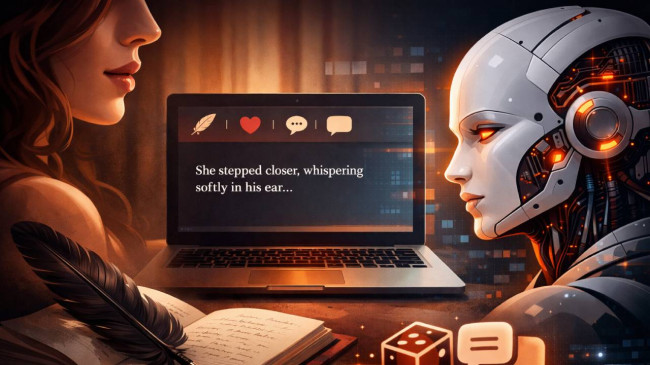
Typical interfaces resemble creative writing software. The user enters a prompt such as a scene description, character setup, or dialogue scenario. The AI then generates paragraphs that extend the story. Users can continue the narrative, modify characters, or regenerate sections.
Some platforms also allow the AI to maintain character memory, so personalities remain consistent across long conversations or stories.
In practice, these tools function less like traditional writing software and more like interactive storytelling engines.
Core Capabilities That Define AI Smut Writer Platforms
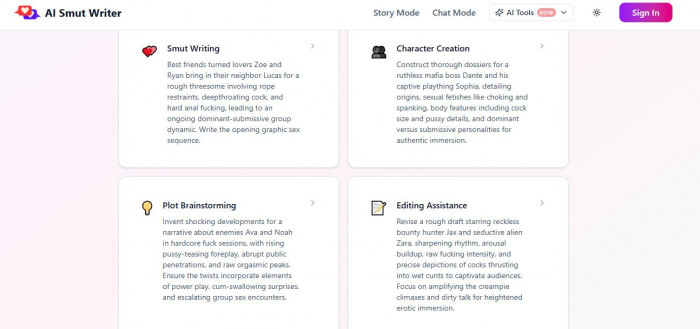
After experimenting with several tools, the most noticeable difference compared with general AI writing assistants is the focus on immersive narrative tools.
Instead of simple text generation, these platforms often include systems designed to simulate fictional characters and evolving storylines.
The most common capabilities include the following:
Character creation systems
Users can design characters with traits, background stories, and personality rules. This allows the AI to respond in ways that match the defined persona.
Scene generation
A short prompt can generate a detailed narrative scene including dialogue, descriptions, and emotional tone.
Roleplay conversation mode
Many platforms allow the AI to act as a fictional character in a chat environment. This is popular in roleplay communities.
Story expansion tools
Writers can highlight a section of text and ask the AI to expand it into a longer narrative.
Editing and rewriting tools
AI can rephrase sentences, adjust tone, or improve pacing within a story.
Memory systems
Some tools remember story context, allowing narratives to continue across long sessions.
The following chart summarizes common capabilities found across several platforms.
Tool Capability Chart
| Capability | Description | Typical Benefit |
| Character Builder | Create detailed fictional personas | Consistent dialogue and personality |
| Scene Generator | AI writes narrative scenes from prompts | Rapid storytelling drafts |
| Roleplay Chat Mode | AI responds as a fictional character | Interactive storytelling |
| Story Expansion | Extend short prompts into longer scenes | Overcome writer's block |
| Context Memory | AI remembers previous dialogue | Long narrative continuity |
| Style Controls | Adjust tone, genre, and pacing | Custom storytelling style |
These tools feel less like word processors and more like collaborative story engines.
What the Typical Writing Workflow Looks Like
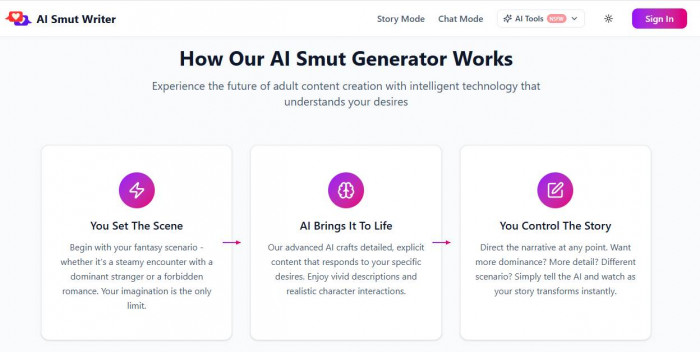
Using these platforms follows a surprisingly simple workflow. Most systems require only a few steps to begin generating narrative content.
Below is a typical workflow observed while testing several AI story generators.
Typical Workflow Step Chart
| Step | User Action | AI Response |
| 1 | Enter story prompt or scenario | AI generates initial scene |
| 2 | Define characters and personalities | AI adjusts dialogue accordingly |
| 3 | Generate continuation | AI expands the narrative |
| 4 | Edit or regenerate sections | AI rewrites text |
| 5 | Continue story progression | AI builds longer narrative arcs |
In practice, the interaction feels like a collaborative brainstorming session with a fictional co writer.
Many writers use the AI to produce rough drafts quickly and then edit the output manually.
Why Writers and Creators Use These Platforms
Across online communities, several motivations appear repeatedly when users discuss these tools.
The most common reason is overcoming writer's block. When a writer struggles to start a scene, a prompt based generator can quickly produce a starting point.
Another advantage is speed. AI can generate thousands of words in minutes. This allows writers to experiment with different directions before committing to a final narrative.
Some writers also use these platforms for world building. AI can quickly generate background lore, character relationships, and dialogue variations.
Fan fiction communities are particularly active users of these tools because they frequently explore alternate storylines and character interactions.
For many creators, the AI is not replacing human writing. Instead, it functions as a creative partner that helps explore ideas faster.
Limitations That Appear in Real Usage
Despite their creative potential, these tools still have several practical limitations.
One noticeable issue is repetition. AI-generated narratives often reuse similar phrasing or descriptive patterns.
Another challenge appears when stories become long. Maintaining consistent character motivations across extended narratives can be difficult for AI systems.
Some platforms also struggle with pacing. Scenes may become overly descriptive without advancing the plot.
Beyond technical limitations, there are also ethical discussions around AI-generated fiction. Writers debate whether AI-assisted storytelling should be disclosed when publishing work.
There are also concerns around dataset sourcing and intellectual property when models are trained on large text corpora.
These debates are not unique to adult writing tools. They exist across the entire AI creative ecosystem.
Pros and Limitations Table
| Category | Strengths | Limitations |
| Speed | Generates scenes instantly | Quality varies |
| Creativity | Produces unexpected ideas | Sometimes repetitive |
| Drafting | Helps overcome writer's block | Requires editing |
| Character simulation | Enables interactive storytelling | Personality drift in long stories |
| Accessibility | Easy for beginners | Ethical debates remain |
Pricing Model Used by AI Smut Writer
AI Smut Writer follows a freemium subscription model. Users can start for free with limited credits, and paid plans unlock higher generation limits, more credits, and advanced AI models.
The platform uses a credit system, where each story generation or continuation consumes credits depending on output length. Free users receive a small number of credits daily to experiment with prompts.
| Plan | Price | Credits | Generation Limits | Key Features |
| Free | $0 | 5 credits daily | Limited story generation | Try the AI generator and explore prompts |
| Casual | ~$7/month | 50 credits daily | Up to 400 stories per month | Premium uncensored AI model and story generation |
| Creator | ~$20/month | 220 credits daily | Up to 1,500 stories per month | Story visualizations, more chat interactions |
| Infinity | ~$75/month | 1200 credits daily | Unlimited stories | Unlimited SmutChat, advanced generation options |
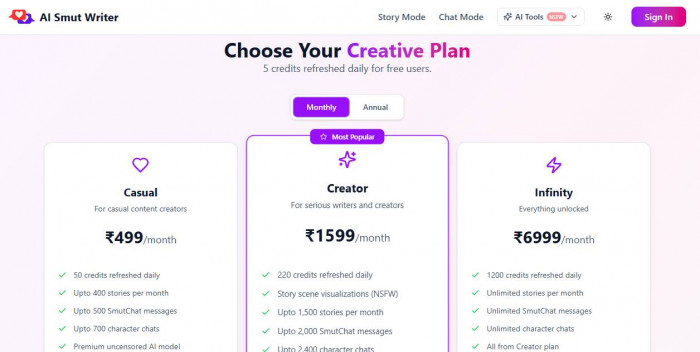
These subscription plans also increase limits for interactive chat and character-based conversations within the platform.
Comparing Major AI Smut Writing Tools
After exploring several AI smut writing platforms, it becomes clear that each tool focuses on slightly different experiences. Some platforms emphasize interactive roleplay conversations, while others are designed mainly for generating personalized adult stories from prompts.
Most tools allow users to define characters, choose scenarios, and generate narrative scenes with minimal restrictions. The main difference lies in how interactive the system is and how much control users have over the story.
| Feature | AI Smut Writer | SmutWriter | SmutFinder | RedQuill |
| Scene Generation | Generates detailed scenes from prompts with multiple regeneration options | Generates adult scenes quickly but with limited customization | Produces personalized scenes based on user preferences and prompts | Creates fantasy or erotic scenes based on scenario input |
| Character Customization | Strong character customization including personality traits and scenario setup | Basic character details can be added but options are limited | Advanced character personalization with detailed preferences | Moderate character setup focusing mainly on scenario roles |
| Roleplay Chat | Supports interactive chat where the AI responds as a character | Limited roleplay interaction, mostly focused on story output | Strong roleplay capability with conversation style storytelling | Limited roleplay features compared with other tools |
| Personalized Story Prompts | Users can define scenario, characters, and tone before generation | Prompts mainly control the story theme and scene style | Prompts include detailed preference settings and scenario selection | Prompts define fantasy or narrative situation |
| Story Editing Tools | Allows regeneration, continuation, and modification of generated scenes | Basic editing features with limited rewrite options | Limited editing tools but strong story continuation | Minimal editing options after generation |
Overall, AI Smut Writer and SmutFinder provide stronger personalization and roleplay features, while SmutWriter and RedQuill focus more on quick story generation from prompts.
Who Actually Uses These Tools
Online discussions show a surprisingly diverse user base.
The largest communities appear to be:
1. independent fiction writers
2. fan fiction creators
3. roleplay communities
4. romance and fantasy storytellers
5. creative hobbyists experimenting with AI
Some users treat the AI like a brainstorming partner, while others build entire interactive story experiences.
A smaller group includes developers experimenting with AI storytelling frameworks.
Interestingly, many writers say the AI is useful for exploring narrative possibilities rather than producing final publishable text.
Where AI Assisted Storytelling Is Heading
AI storytelling platforms are evolving rapidly.
Newer systems are beginning to include longer context windows, allowing them to track entire novels rather than short scenes.
Developers are also experimenting with memory graphs, which allow AI characters to remember past events, relationships, and emotional states.
Another emerging feature is interactive story engines, where readers can influence narratives in real time.
As generative AI models improve, these tools may begin to blur the line between writing software, roleplay platforms, and narrative game engines.
For now, AI smut writer platforms occupy a niche but growing space inside the broader AI writing ecosystem. They highlight an important trend in generative technology.
Different communities want AI tools tailored to their creative workflows, and storytelling is one of the areas where that demand is strongest.


Comments