
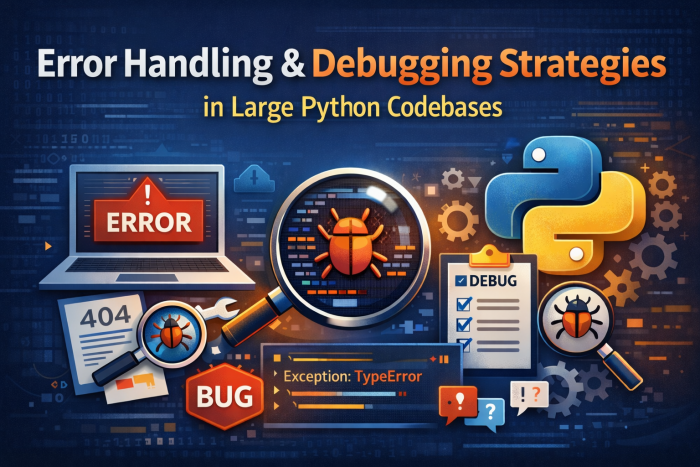
As Python projects grow, they also become harder to manage. Small scripts turn into applications with hundreds of files, multiple teams, and complex dependencies. In such environments, errors are unavoidable. What matters most is how those errors are handled and how quickly developers can trace and fix them. Strong error handling and debugging practices keep large Python codebases stable, readable, and easier to maintain over time.
Learners who start with an Advance Python Course slowly understand that writing correct code is only part of the job. Handling failures gracefully and debugging efficiently are equally important skills, especially in real production systems.
Why Error Handling Becomes Critical at Scale?
In small programs, an error usually stops execution and prints a message. In large applications, this approach is risky. One unhandled exception can crash an entire service or affect thousands of users.
In large Python codebases:
● Errors can originate far from where they appear.
● One failure can trigger many side effects.
● Logs may span multiple services or modules.
● Silent failures are more dangerous than visible ones.
Proper error handling helps developers control failures instead of reacting to them after damage is done.
Using Exceptions, the Right Way
Python’s exception system is powerful, but misusing it creates confusion, in large codebases, exceptions should be meaningful.
Good practices include:
● Catch only specific exceptions, not everything.
● Raise errors with clear messages.
● Avoid hiding errors without logging them.
● Let critical exceptions fail loudly.
Developers attending Python Online Classes learn that try and except blocks should protect risky operations. This keeps debugging focused and avoids masking real problems.
Creating Custom Exceptions for Clarity
Large projects often define custom exceptions, which makes it easier to understand what went wrong without reading internal code.
For example:
● Database Connection Error
● Invalid User Input Error
● Configuration Missing Error
Custom exceptions help teams:
● Handle different error types differently.
● Improve readability of the code.
● Make debugging faster.
In an Advance Python Course, learners see how custom exceptions improve communication between modules and teams.
Centralized Logging Instead of Print Statements
Print statements may work during early development, but they are not suitable for large systems. Logging provides structure and context.
Effective logging includes:
● Error type and message.
● File and function name.
● Time of occurrence.
● Stack trace when needed.
Students in Python Online Classes practice using Python’s logging module to capture errors. Logs become the first place developers look when something breaks in production.
Debugging Step by Step Instead of Guessing
Debugging large systems requires patience and structure. Guessing usually leads to more bugs.
Effective debugging steps include:
● Reproducing the issue consistently.
● Narrowing down where the failure starts.
● Inspecting inputs and outputs.
● Checking recent changes.
● Using breakpoints instead of rewriting code.
Developers in Python Classes in Gurgaon learn to debug by isolating the problem rather than scanning the entire codebase at once.
Using Debugging Tools Effectively
Python offers several tools that make debugging easier, even in complex systems.
Common tools include:
● PDB for step by step inspection.
● IDE debuggers for breakpoints and variable tracking.
● Stack traces for understanding call flow.
● Assertions for catching invalid states early.
Learning how to use these tools correctly saves hours of manual investigation.
Handling Errors Across Modules and Layers
Large Python applications often have layers such as API, and external services, where errors should be handled at the right layer.
Best practices include:
● Validate inputs at boundaries.
● Handle external failures close to where they occur.
● Avoid passing raw exceptions across layers.
● Translate low level errors into meaningful messages.
An Advance Python Course helps learners understand where errors should be caught allowing to propagate.
Writing Defensive Code Without Overcomplicating
Defensive coding means anticipating failure without cluttering the code.
This includes:
● Checking for null or missing values.
● Validating configuration at startup.
● Guarding against invalid states.
● Failing early when assumptions break.
Students in Python Online Classes learn that defensive coding is about balance, where too little causes crashes. Too much makes the code unreadable.
Testing as a Debugging Companion
Testing is not separate from debugging. In large systems, tests often reveal bugs before users do.
Effective tests:
● Cover edge cases.
● Validate error paths.
● Ensure exceptions are raised correctly.
● Protect against regression.
Learners in Python Classes in Gurgaon see how failing tests often point directly to broken logic.
Common Mistakes in Large Python Codebases
Some mistakes appear again and again:
● Catching broad exceptions with ignoring them.
● Logging errors without context.
● Mixing business logic with error handling.
● Debugging without reproducing the issue.
● Fixing symptoms instead of root causes.
Training helps developers recognize these patterns early avoiding them.
How Training Improves Debugging Confidence?
Error handling and debugging are skills built through practice, where training environments provide safe spaces.
Through guided exercises, learners:
● Debug broken applications.
● Analyze real error logs.
● Improve exception design.
● Learn how professionals handle production failures.
An Advance Python Course focuses on real scenarios rather than toy examples, preparing learners.
Conclusion
In large Python codebases, errors are not a sign of failure, they are part of the system’s reality. What defines a strong developer is the ability to handle those errors cleanly and debugging. With structured exception handling, and the right tools, Python applications remain stable. Proper training turns debugging from a stressful task into a confident with systematic process that supports long term.









Comments