
Truck accidents occupy a distinct category within traffic-related injuries, not because they happen more often, but because they operate under an entirely different risk framework.
When commercial vehicles weighing tens of thousands of pounds share the road with passenger cars, the margin for error shrinks dramatically.
The consequences of failure, mechanical, human, or systemic, are often severe, permanent, and legally complex.
Unlike standard car collisions, truck-related incidents rarely involve a single point of failure.
They emerge from layered systems: corporate policies, regulatory compliance, driver fatigue management, maintenance schedules, and logistical pressures.
Understanding this ecosystem is essential for evaluating responsibility when a serious crash occurs.

Commercial Trucking Introduces Industrial-Scale Risk
Large trucks are governed by operational standards closer to industrial machinery than personal vehicles.
Federal and state regulations dictate how long drivers can operate, how cargo must be secured, and how vehicles are inspected and maintained.
When these standards are ignored or bent to meet delivery deadlines, risk accumulates silently until it manifests on the roadway.
Truck collisions often reveal failures that predate the crash by weeks or months.
Skipped inspections, overloaded trailers, falsified logs, or inadequate training can all contribute to catastrophic outcomes.
These are not momentary lapses; they are systemic vulnerabilities.
Responsibility Rarely Stops With the Driver
One of the most misunderstood aspects of truck accident claims is the assumption that the driver alone bears responsibility.
In reality, commercial trucking operates through layered accountability.
Drivers, fleet operators, maintenance contractors, freight brokers, and manufacturers may all play a role in how and why a collision occurred.
Identifying liability requires tracing decisions backward, examining hiring practices, route planning, equipment servicing, and compliance records.
This process demands access to records that are not publicly available and are often tightly controlled by corporate entities.
Without proper legal pressure, critical evidence may never surface.
Evidence in Truck Cases Is Time-Sensitive and Fragile
Truck accident investigations rely heavily on technical data.
Electronic logging devices, onboard computers, GPS systems, and maintenance databases can provide precise insights into speed, braking, hours of service, and mechanical performance.
However, much of this data can be overwritten, lost, or legally shielded if not preserved quickly.
Delay benefits corporate defendants.
As time passes, vehicles are repaired, logs are updated, and records become harder to reconstruct accurately.
Early intervention is often the difference between a provable claim and one built on inference.
Severity of Injury Changes the Legal Equation
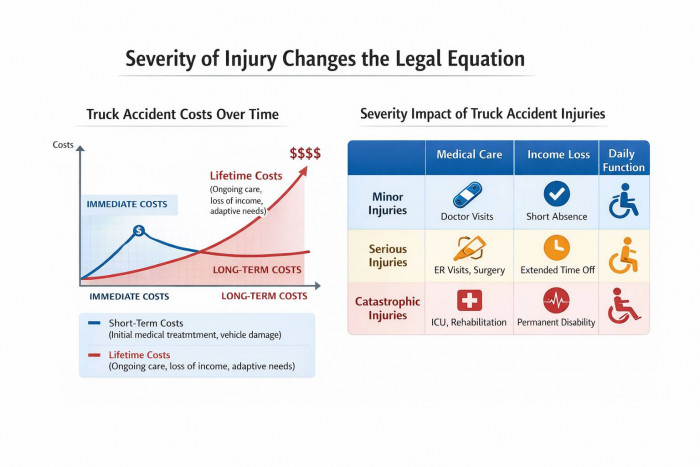
Truck collisions frequently result in injuries that alter lives permanently.
Traumatic brain injuries, spinal cord damage, complex fractures, and internal organ trauma are far more common than in typical auto accidents.
These injuries carry long-term medical, financial, and psychological consequences.
From a legal standpoint, severity changes everything.
Damage calculations must account not just for immediate treatment, but for lifelong care, diminished earning capacity, adaptive equipment, and loss of independence.
Generic settlement formulas fail to capture these realities.
Corporate Defense Strategies Are Structurally Aggressive
Trucking companies and their insurers approach claims with institutional resources.
Defense teams often include investigators, engineers, medical consultants, and legal specialists whose sole role is to limit exposure.
Their strategies are proactive, not reactive.
Common tactics include reframing causation, disputing injury permanence, or shifting blame through comparative fault arguments.
These defenses are rarely obvious to injured individuals, yet they shape negotiations from the outset.
Understanding these dynamics is critical to maintaining leverage.
Regional Legal Knowledge Shapes Accountability
Commercial trucking cases are influenced heavily by jurisdictional interpretation.
Local courts develop reputations for how they handle corporate negligence, evidentiary standards, and damage assessments.
Procedural nuances can affect everything from filing strategy to trial posture.
In South Carolina, where fault allocation and compliance obligations play a decisive role, localized legal insight becomes indispensable.
For those facing the aftermath of a commercial truck collision, consulting an experienced Truck accident lawyer in Greenville can help align case strategy with regional legal expectations rather than relying on generalized assumptions.
Regulatory Violations Often Reveal the Core of the Case
Truck accident litigation frequently turns on regulatory compliance.
Federal Motor Carrier Safety Regulations establish clear operational boundaries, and violations can serve as powerful evidence of negligence.
Patterns of noncompliance, rather than isolated errors, often indicate systemic disregard for safety.
Analyzing driver logs, inspection reports, and company policies can uncover these patterns.
When violations align with crash circumstances, they provide a legally persuasive narrative of preventable harm.
Long-Term Outcomes Depend on Early Strategic Choices
The earliest decisions made after a truck accident often have lasting consequences.
Statements given, medical care pursued, and evidence preserved all influence how a claim unfolds months or years later.
Once missteps occur, correcting them becomes difficult or impossible.
Strategic clarity early in the process allows claims to develop on solid footing.
It ensures that investigation, documentation, and negotiation proceed with long-term impact in mind rather than short-term relief.
Closing Reflection: Truck Accidents Expose Systemic Failures
Truck accidents are not merely traffic incidents, they are indicators of broader system breakdowns.
They expose the consequences of cutting corners, prioritizing efficiency over safety, and neglecting regulatory responsibility.
For those injured, the path to accountability requires more than basic legal understanding.
A thorough, informed approach recognizes the scale of the problem and addresses it accordingly.
In cases involving commercial vehicles, justice is not just about recovery; it is about accountability across the entire system that allowed harm to occur.







Comments