
An injury does not begin as a lawsuit. It begins as disruption.
A missed paycheck. A surgery scheduled unexpectedly. A routine day replaced by physical limitation. The legal process enters only after the practical consequences become unavoidable.
Personal injury law exists to shift financial responsibility when harm results from preventable conduct. But that shift does not happen automatically. It must be constructed through evidence, timing, and strategic positioning.
The strength of a claim depends less on the severity of the incident and more on how methodically it is developed.
The Legal Framework Behind Injury Liability
Every successful injury case must establish four interconnected components:
1. A duty of care owed by one party
2. A failure to meet that duty
3. A direct causal link between that failure and the injury
4. Verifiable damages
The duty may arise from operating a vehicle, maintaining property, supervising premises, or manufacturing a product. Breach occurs when reasonable standards are not followed.
Causation is often the most contested element. Defendants frequently argue that injuries existed beforehand or resulted from unrelated factors. That is why early documentation becomes decisive.
Negligence is not assumed. It is demonstrated.
Evidence Is Layered, Not Singular
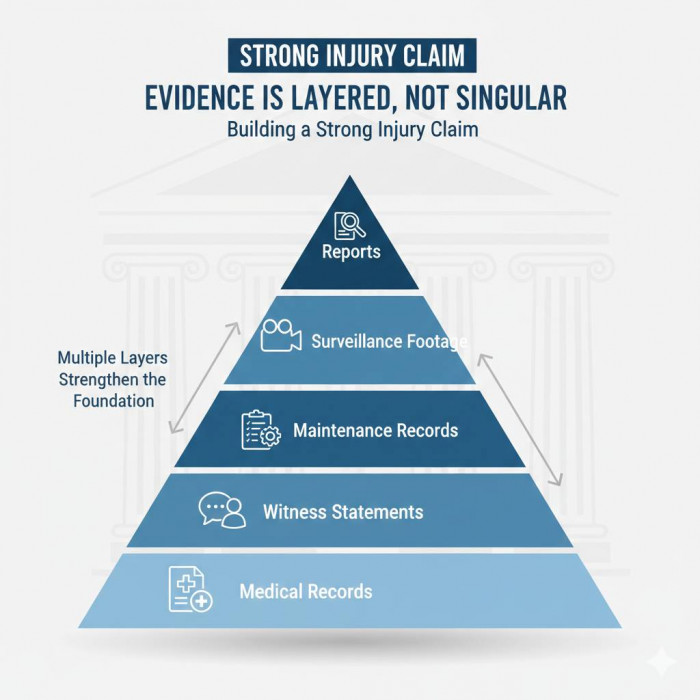
Many people believe a case hinges on one defining document: a police report, an incident form, or a medical record. In reality, strong claims are layered.
They may include:
● Surveillance footage
● Maintenance logs
● Safety policy records
● Witness affidavits
● Photographic documentation
● Expert evaluations
When multiple forms of evidence align, disputes narrow. When gaps appear, liability arguments widen.
The goal is consistency across independent sources.
Measuring the True Cost of Injury
Injury cases are rarely about a single hospital invoice. They involve cascading financial effects.
Direct losses may include:
● Emergency treatment
● Surgical intervention
● Medication
● Physical rehabilitation
● Lost wages
Indirect consequences may extend further:
● Reduced earning potential
● Career disruption
● Permanent physical restrictions
● Ongoing therapeutic support
Future damages often require projections supported by medical opinion and economic analysis. Insurance carriers typically resist speculative numbers unless backed by professional assessments.
Long-term exposure is the most negotiated aspect of any claim.
Defense Strategy: Where Cases Are Commonly Challenged
Opposing parties often focus on weakening one of three areas:
● Causation (arguing the injury pre-existed)
● Proportional fault (alleging shared responsibility)
● Damage scope (minimizing long-term impact)
Even minor inconsistencies in treatment history or documentation can be amplified during negotiations.
Understanding these pressure points allows injured individuals to anticipate rather than react.
The Negotiation Phase: Calculated Risk on Both Sides
Settlement discussions are structured around risk assessment.
Insurers evaluate:
● Probability of losing at trial
● Potential jury reaction
● Projected defense costs
● Severity of documented injury
Initial offers often reflect conservative assumptions. As evidence strengthens, valuation typically adjusts.
Timing matters. Negotiating too early can limit compensation. Waiting without documentation can weaken leverage.
Balance is critical.
When Escalation Becomes Strategic
Not all disputes resolve voluntarily. When settlement offers fail to reflect documented losses or when liability is denied entirely, formal litigation may become necessary.
Filing suit introduces procedural safeguards:
● Court-supervised evidence exchange
● Sworn depositions
● Expert testimony disclosures
● Independent medical evaluations
This stage shifts the claim from informal bargaining to structured adjudication.
In higher-value cases involving substantial medical costs or permanent impairment, injured individuals often seek evaluation from an experienced Orlando Personal Injury Lawyer to determine whether continued negotiation is viable or whether litigation provides stronger leverage. The decision is rarely emotional. It is rooted in projected recovery, evidentiary strength, and comparative risk.
Litigation does not guarantee trial. It recalibrates negotiating dynamics.
The Expanding Role of Expert Testimony
As injury cases grow more complex, the role of expert analysis becomes increasingly central. Insurance companies rely on internal medical reviewers and statistical models to limit exposure. To counter that, claimants often need independent specialists who can translate medical reality into legally persuasive conclusions.
Medical experts may evaluate whether an injury is temporary or permanent within a reasonable degree of medical probability. That distinction alone can dramatically affect compensation. A temporary soft tissue strain is valued differently than a documented spinal impairment with long-term functional limitations.
Vocational rehabilitation specialists assess how an injury impacts a person’s ability to return to prior employment. If physical restrictions prevent resuming the same role, experts may evaluate alternative employment options and wage differences. Economists then project how those limitations translate into lifetime earnings loss, factoring inflation, work-life expectancy, and career trajectory.
In cases involving vehicle collisions or structural failures, accident reconstructionists may analyze force dynamics, impact angles, and biomechanical data to demonstrate how the injury occurred. Their testimony can rebut claims that an injury was minor or unrelated.
Expert testimony converts speculation into structured projection. It gives courts and insurers a framework grounded in methodology rather than assumption. Without it, long-term damages often appear uncertain, and uncertainty typically favors the defense.
Non-Economic Harm: Proving What Cannot Be Seen
Financial losses can be calculated with invoices and pay stubs. Human suffering requires a different form of proof.
Chronic pain can alter posture, sleep quality, and concentration. Anxiety may affect a person’s ability to drive, socialize, or work effectively. Lifestyle changes, avoiding travel, withdrawing from recreational activities, or limiting physical interaction, reshape daily life in subtle but lasting ways.
Courts acknowledge these harms because the law recognizes that injury is not purely economic. However, acknowledgment does not mean automatic valuation. Documentation remains essential.
Consistent medical records that note pain levels, functional limitations, and emotional responses strengthen credibility. Psychological evaluations can formally diagnose trauma-related conditions. Statements from family members or colleagues may demonstrate observable behavioral change.
When non-economic harm is unsupported, insurers often minimize it as temporary discomfort. When documented consistently and professionally, it becomes a legitimate component of damages rather than an afterthought.
The difference lies in substantiation.
The Importance of Early Structure
The foundation of an injury case is laid almost immediately after the incident. Early choices create either clarity or vulnerability.
Prompt medical attention not only protects health but establishes temporal connection between the incident and the injury. Delayed treatment opens the door to causation disputes. Preserving photographs, incident reports, and witness information ensures that liability arguments remain grounded in tangible evidence.
Financial tracking matters just as much. Maintaining organized records of medical bills, transportation expenses, prescription costs, and lost income prevents later reconstruction based on memory alone. Small overlooked expenses accumulate over time and, if unrecorded, are rarely recoverable.
Early communication decisions also influence outcomes. Casual statements about fault, informal apologies, or inconsistent narratives may later be interpreted unfavorably. A consistent and measured approach protects credibility.
Personal injury litigation often appears to revolve around courtroom arguments, but by that stage, the trajectory has largely been determined. Cases are rarely won or lost in dramatic moments. They are shaped by steady documentation and structured decisions from the very beginning.
An injury claim does not emerge fully formed at filing. It evolves from the first recorded fact, the first medical note, the first preserved piece of evidence.
That early structure defines the eventual result..
The Broader Purpose of Injury Law
At its core, personal injury litigation reallocates financial burden from the injured party to the responsible one.
Without structured claims, the cost of preventable harm becomes a private hardship.
The legal system provides a mechanism for correction, but only when supported by evidence, preparation, and strategy.
Injury law is not about conflict. It is about accountability measured carefully and deliberately.










Comments