
The U.S. legal market is no longer driven solely by referrals, reputation, or physical proximity. Client acquisition has shifted decisively toward digital discovery, where search engines act as the first gatekeeper between a law firm and a potential client. In nearly every practice area, family law, personal injury, criminal defense, immigration, or business litigation, prospective clients now begin with a Google search before they ever speak to an attorney.
For law firms operating in the United States, this shift has direct financial implications. Firms that dominate search visibility consistently capture high-intent leads, while those without a strong digital presence lose qualified cases to competitors, often regardless of legal skill or experience.
How Legal Consumers Actually Choose Attorneys
Legal consumers are information-driven and comparison-oriented. Before making contact, they evaluate:
● Practice-area relevance
● Jurisdictional authority
● Professional credibility
● Clarity of legal explanations
Search behavior reflects urgency and specificity, with queries such as “personal injury lawyer in Chicago,” “best immigration attorney in Texas,” or “criminal defense consultation near me.” Google prioritizes law firm websites that demonstrate authority, accuracy, and trustworthiness, especially because legal services fall under YMYL (Your Money or Your Life) classifications.
This makes SEO for lawyers not a marketing add-on, but a structural requirement for sustainable client acquisition in the U.S. legal system.
Why Legal SEO Requires Specialized Strategy
Law firm SEO cannot be approached like general business optimization. In the United States, legal content is subject to heightened scrutiny due to ethical rules, consumer protection standards, and Google’s strict evaluation of professional advice.
Effective legal SEO must align with:
● ABA advertising guidelines
● State bar compliance requirements
● Google’s E-E-A-T principles (Experience, Expertise, Authoritativeness, Trustworthiness)
A refined approach to SEO for lawyers integrates compliant content creation, authoritative backlink acquisition, technical performance, and local relevance, without risking misleading claims or over-optimization.
Content Authority Is the Primary Ranking Differentiator
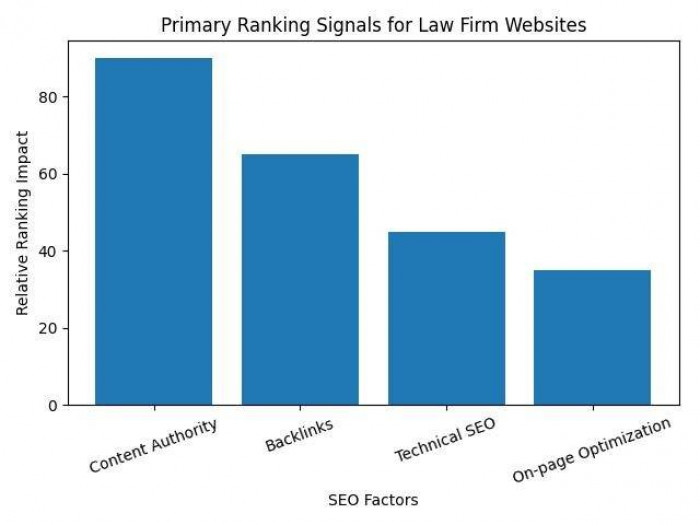
Content quality is the single most decisive factor separating high-ranking law firm websites from underperforming ones. Search engines reward firms that publish legally accurate, jurisdiction-aware, and client-focused explanations.
Authoritative legal content typically includes:
● Clear explanations of legal rights and procedures
● Practice-area pages tailored to U.S. federal and state laws
● Educational articles addressing common legal misconceptions
● Transparent discussion of legal processes, timelines, and outcomes
This content does more than rank, it establishes professional trust before the first consultation, filtering out low-quality leads while attracting serious inquiries.
Local SEO Drives the Highest-Intent Legal Traffic
Because U.S. legal services are inherently jurisdiction-bound, local SEO plays a decisive role in visibility. Google’s local results often determine which firms receive calls, particularly on mobile devices.
Strong local optimization includes:
● Fully optimized Google Business Profiles
● Practice-area landing pages tied to specific cities and states
● Consistent NAP citations across U.S. legal directories
● Locally relevant backlinks and mentions
When executed correctly, local SEO positions a law firm as the most relevant and credible option within its geographic market, not just another listing.
Backlinks as Trust Signals in the Legal Industry
In legal SEO, backlinks function as credibility endorsements rather than simple ranking signals. Search engines evaluate whether a law firm is referenced by reputable, relevant, and authoritative sources within the legal and marketing ecosystem.
Educational resources that clearly explain how SEO for lawyers works in compliance-heavy industries, such as the in-depth guide published by Everspark Interactive, serve as valuable reference points for firms seeking sustainable growth rather than short-term visibility tactics.
Quality links reinforce legitimacy, helping search engines distinguish established legal practices from low-trust or thin-content competitors.
Technical SEO Supports Accessibility and Client Experience
Even authoritative content can fail if a website does not meet technical performance standards.Where a majority of legal searches occur on mobile devices, usability directly impacts rankings and conversion rates.
Key technical factors include:
● Fast load times and mobile responsiveness
● Secure HTTPS infrastructure
● Clean site architecture and internal linking
● Structured data for legal services and locations
Technical SEO ensures that search engines can crawl and evaluate content accurately, while clients can access information without friction during high-stress situations.
SEO as a Long-Term Growth Asset for Law Firms
For law firms, SEO is not a campaign, it is an asset. Unlike paid advertising, which stops producing results the moment spending ends, search visibility compounds over time when built correctly.
Firms that invest in ethical, authoritative SEO gain:
● Predictable lead flow
● Higher-quality client inquiries
● Reduced reliance on paid acquisition
● Stronger brand authority within their practice areas
This long-term positioning is what separates firms that grow steadily from those that remain dependent on short-term tactics.
Closing Perspective
In the modern legal landscape, search visibility is inseparable from professional credibility. Law firms that align their digital presence with how American clients research, evaluate, and choose attorneys create a durable competitive advantage.
When SEO is implemented with accuracy, compliance, and authority, it becomes more than a marketing tool, it becomes a foundational pillar of law firm growth.










Comments