
An accident rarely feels like a turning point when it happens.
There’s confusion, a rush of people asking questions, and an almost instinctive urge to say, “I’m fine.” Most people don’t realise that this moment, the moment when nothing feels settled, quietly shapes everything that follows.
What comes after is rarely dramatic. It’s slower. More subtle. Pain that lingers. Sleep that feels lighter. A growing list of tasks you didn’t expect to manage while recovering. And somewhere in the background, the legal and financial consequences begin forming long before anyone explains them to you.
That sense of “something changed, but I’m not sure what yet” is where many injury journeys truly begin, and it leads directly to the first set of mistakes people don’t even realise they’re making.
And those mistakes usually start with good intentions.
The moment things quietly start to go wrong

Most injured people try to do the “right” thing.
They answer insurance calls politely. They delay medical visits hoping the pain will fade. They assume honesty alone will protect them.
The problem is that injury claims aren’t evaluated emotionally, they’re evaluated structurally.
A short delay between the accident and medical treatment can raise questions later. A casual comment like “I’m feeling better today” can be interpreted as recovery, even if tomorrow feels worse. Gaps in treatment, even reasonable ones, can be framed as lack of seriousness.
None of this is intuitive. And none of it feels fair in the moment.
That’s why consumer legal resources like Forbes Advisor repeatedly stress understanding how personal injury law actually works behind the scenes, not how people assume it works: https://www.forbes.com/advisor/legal/personal-injury/personal-injury-law/
Once people realise the system values consistency over context, a deeper concern often follows: what exactly counts as harm?
Why injuries affect more than your body
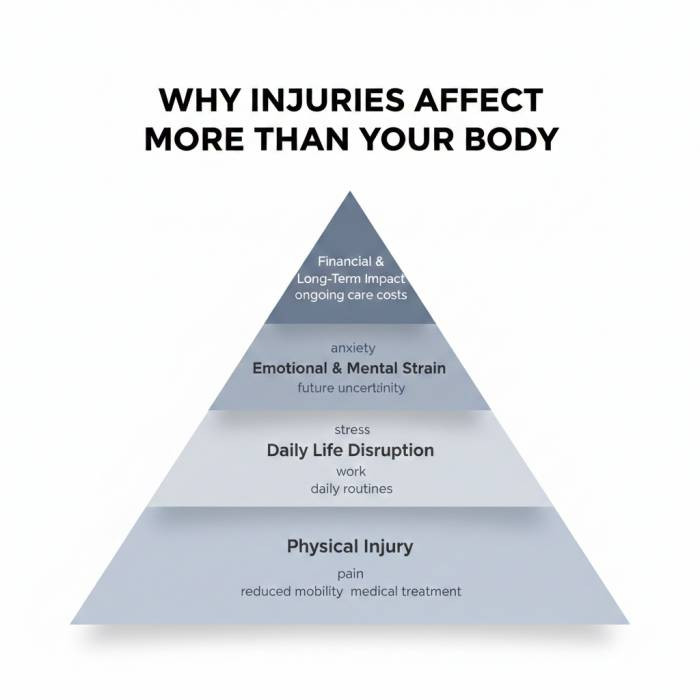
Pain is easy to understand. Disruption is harder to explain.
An injury doesn’t just hurt, it rearranges daily life. It changes how long tasks take, how confident you feel moving around, how often you second-guess yourself before doing something ordinary. These changes rarely show up neatly on medical bills, yet they shape recovery just as much as physical treatment.
Lost work hours don’t always appear as a single missed paycheck.
Stress doesn’t arrive with an invoice.
Sleep disruption isn’t itemised.
When injury claims focus only on surface-level costs, they miss how deeply an accident can ripple through someone’s routine. That’s often when people begin wondering whether the system will ever fully “see” what they’re dealing with, which leads them to consider who actually speaks on their behalf.
Why location quietly shapes your outcome
One detail people underestimate is geography.
Personal injury law may sound universal, but how it’s applied depends heavily on where the case is handled. Filing deadlines, comparative fault rules, settlement patterns, and even court pacing vary from one region to another.
For someone dealing with an injury along California’s Central Coast, working with a San Luis Obispo Personal injury attorney can help bridge the gap between written law and real-world practice, how insurers behave locally, what documentation courts expect, and what timelines are realistic.
That local awareness often prevents small procedural issues from becoming long-term problems, which naturally raises another question many people hesitate to ask.
Why legal help doesn’t always mean a lawsuit
There’s a lingering belief that calling a lawyer is an aggressive move, that it immediately escalates conflict. In practice, it usually does the opposite.
Most personal injury cases are resolved without ever stepping into a courtroom. The difference is that once legal representation is involved, conversations gain structure. Communication becomes intentional. Medical records are organised. Future implications are considered instead of just immediate relief.
Instead of reacting to insurance requests, injured individuals gain space to focus on healing while someone else manages the technical side of the claim. That shift from reaction to preparation is often where stress levels quietly drop.
Still, not all legal support feels the same, which makes choosing the right help an important decision in itself.
Knowing when guidance feels supportive, not sales-driven
The right legal conversation doesn’t feel rushed.
It doesn’t rely on pressure.
And it doesn’t promise certainty where none exists.
A good personal injury attorney explains possibilities, not guarantees. They talk openly about risks, timelines, and what’s realistically recoverable. Most importantly, they leave space for questions, even the ones that feel basic or uncomfortable.
If a consultation feels more like a pitch than a discussion, that’s usually a signal to pause. Legal support should reduce confusion, not add another layer of it.
And once that clarity is in place, people often realise they’re finally ready for the part that matters most, moving forward.
Moving ahead with fewer unanswered questions
An injury can take away a sense of control in ways people don’t expect. Decisions feel heavier. Outcomes feel uncertain. And the mental load can linger long after physical healing begins.
What restores balance isn’t confrontation, it’s understanding. Knowing where you stand. Knowing what matters. Knowing what steps protect you rather than complicate things later.
With the right information and the right support, recovery becomes less about navigating a system alone and more about rebuilding confidence one step at a time.
And sometimes, that shift, from uncertainty to clarity, is the most meaningful part of healing.









Comments